[English below] Die Linie und die Zeichnung sind zentrale Aspekte meiner interdisciplinären künstlerischen Ausdrucksweise.
Im Sommer 2025 wurde ich eingeladen an einer spannenden Projekt Serie der GEDOK Brandenburg Teil zu nehmen: DIALOG:LINIE.
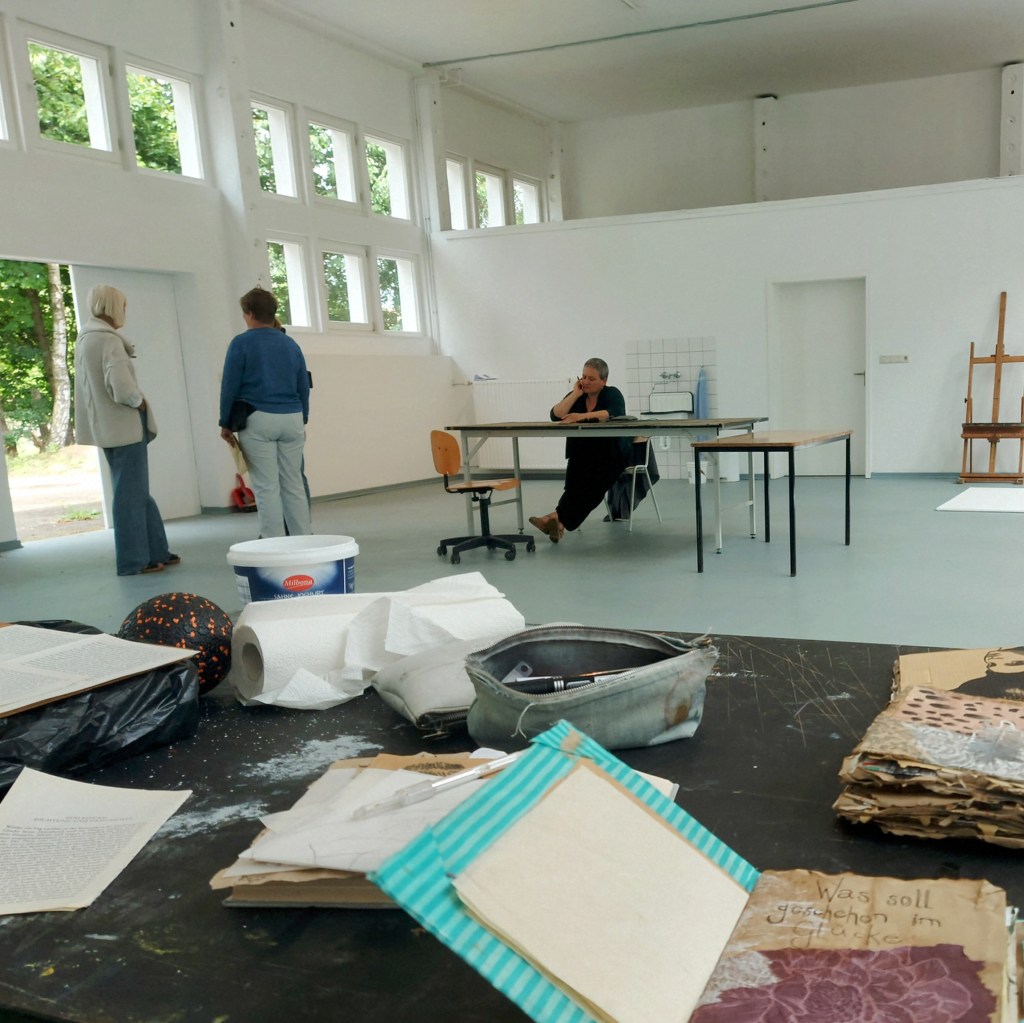
Den Auftakt bildete eine Mini-Residence: Zwei Tage. Zwei Künstlerinnen. Ein Raum. – in der Adelheid Fuss und ich gemeinsam das Thema ‘Zeichnung und Raum’ erforschen konnten. Im Anschluss gab es dazu eine Ausstellung der entstandenen Arbeiten und Prozesse.
Ich freue mich, dass es nun ein Video gibt von einem Interview mit Adelheid Fuss und mir, in dem wir über das Projekt und unsere Erfahrungen reden.
Zusätzlich teile ich hier unter dem Video auch noch weitere Gedanken von mir zu dem Thema, die ich mir für das Künstlerinnengespräch zur Eröffnung mit Kaj Osteroth notiert hatte.
Film: Kaj Osteroth und Timothy Speed, 2025.
Vielen Dank an die GEDOK Brandenburg, Kaj Osteroth und Timothy Speed für diesen Film.
Mehr Infos und Bilder zu dem Projekt und der Ausstellung findet ihr HIER.
Interviewfragen zur Eröffnung der Ausstellung
Geführt von Kaj Osteroth
Kaj Osteroth: In einem Interview mit Carola Hartlieb-Kühn sagst du: „Ich benutze die Äste, um einen Fluss zu zeichnen.“ Das klingt nicht nur sehr schön und beinahe poetisch sondern bietet auch einen großzügigen, erweiterten Begriff der Zeichnung. Würdest du zu deinem Begriff der Zeichnung deine Gedanken mit uns teilen?

Imke Rust: Ich arbeite sehr vielseitig und unterschiedlich und habe dann irgendwann festgestellt, dass einer der sprichwörtlichen roten Fäden in meiner Arbeit eigentlich die Linie ist.
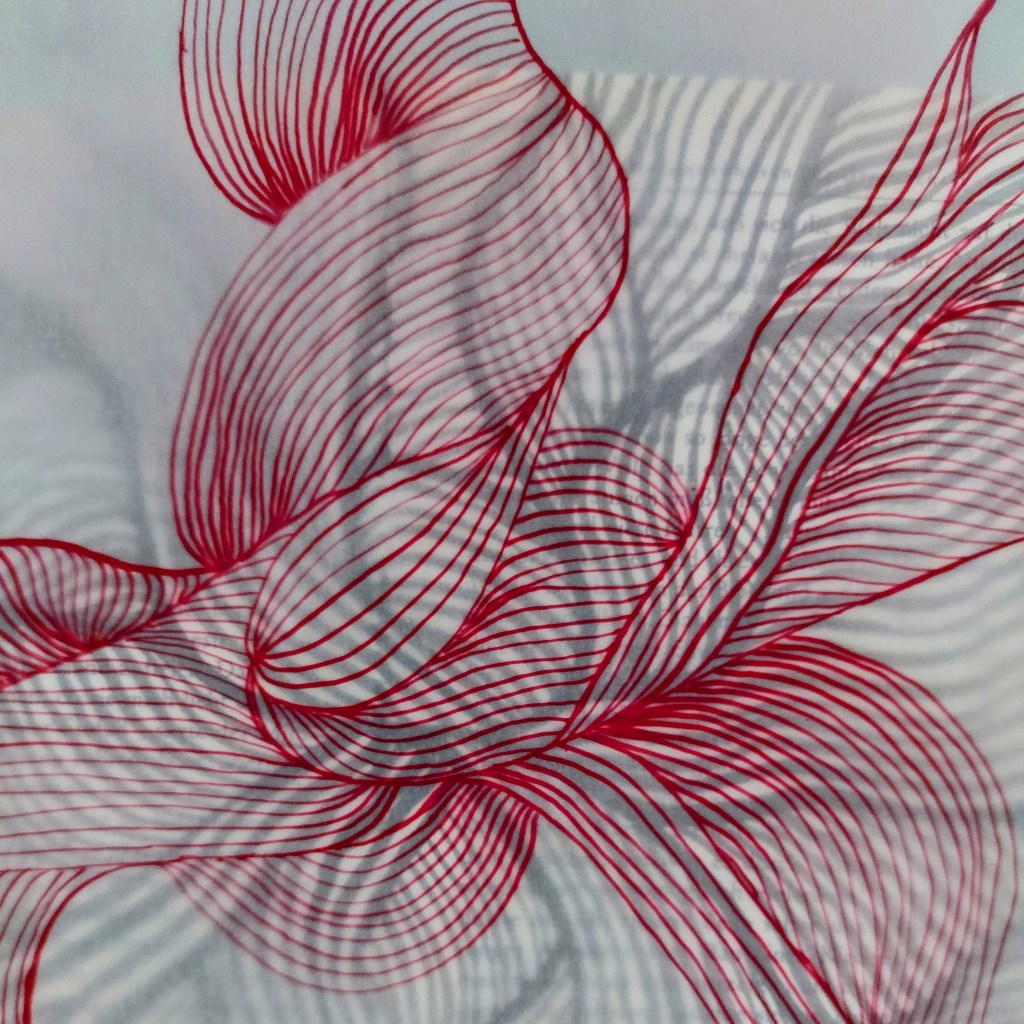
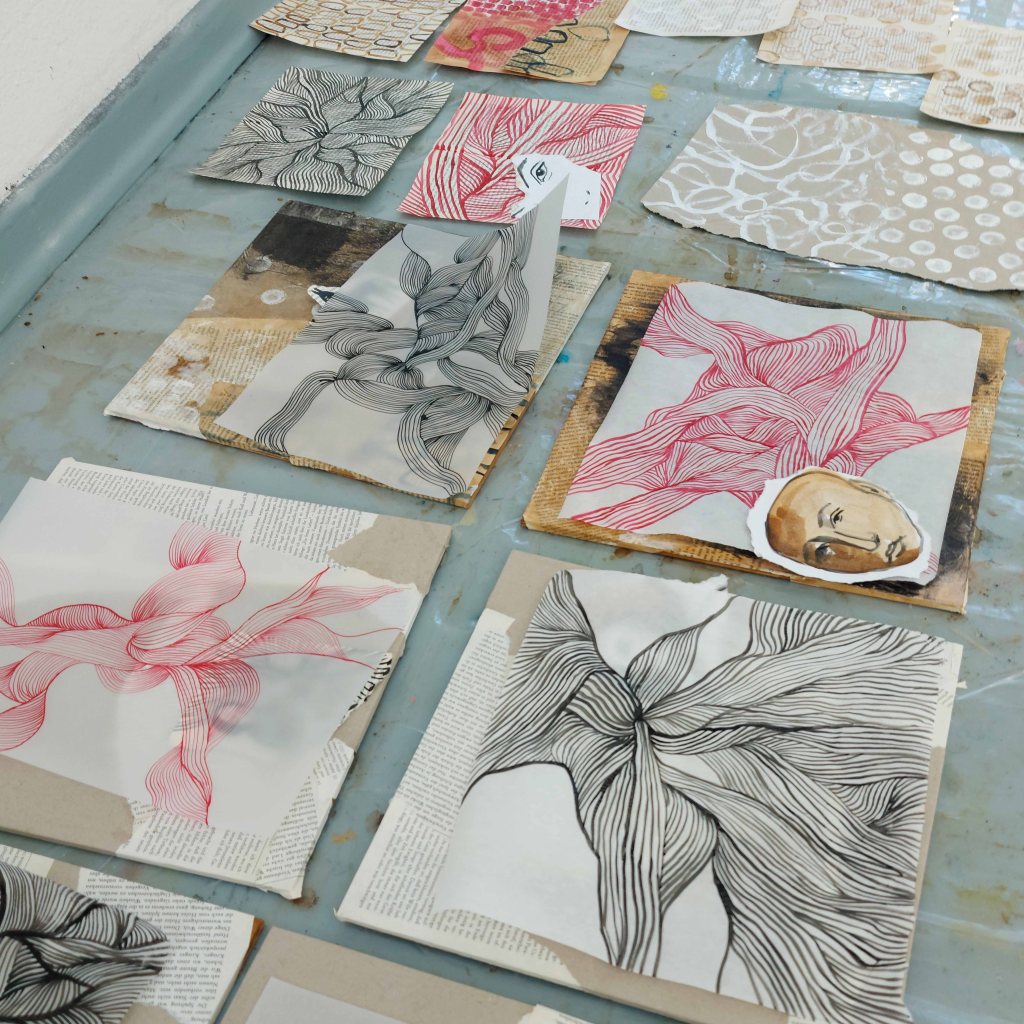
Ich denke und sehe in Linien. Vor allem die unsichtbare Linien, die Verbindungen auftun, aber auch Linien die Dinge umschreiben, Klarheit schaffen und durch ihre Präsenz auch auf die Zwischenräume aufmerksam machen.
Die Linie drückt für mich sehr stark Gefühle aus und lenkt unsere Wahrnehmung. Ich liebe die einfache Bleistift Linie oder Zeichnung auf Papier, aber finde es total spannend, sie weiter zu denken: Als dreidimensionale große Linie im Raum oder in der Landschaft, die sehr vergängliche Linie die ein Windhauch zeichnet oder etwa die vielen geistigen Linien die in meinem Kopf entstehen, zwischen Ideen, Gegebenheiten oder unterschiedlichen Themen.
Kaj Osteroth: Du bist Beobachterin und Teil eines großen Ganzen. Wolken, Termiten, Systeme und Strukturen werden zu Bild, zu Kunst. Viele dieser Aspekte sind auch hier in der gemeinsam entwickelten Installation wiederzuerkennen. Wie sieht bei dir eine Annäherung an einen neuen Raum aus?
Imke Rust: Ich neige wirklich dazu immer gerne das große Ganze zu denken. Wenn ich also einen neuen Raum oder Projekt begegne, versuche ich die Gegebenheiten zu überblicken und mich dann drauf einzulassen, welche Linien – also Verbindungen – entstehen wollen.
Zwischen allen Ideen, all den schon bestehenden Arbeiten, den Räumen und in diesem Fall die Verbindungen zu den Arbeiten und dem Dialog von und mit Adelheid Fuss.
Ich fange meist mit einer Idee an oder einem Aspekt der mich grade besonders anspricht und verfolge, welche Linien sich bilden wollen. Dabei arbeite ich sehr intuitiv und offen, aber am Ende ist es wichtig, dass in meinem Gefühl jede Linie und jede Verbindung stimmt. Nicht nur die offensichtlichen, sondern auch die auf den Meta-ebenen.
Viele anfängliche Linien werden dann auch wieder fallengelassen oder geändert, aber sie waren wichtig um mich in eine gewisse Richtung zu führen.
Kaj Osteroth: Bei der Begegnung vor Ort während eures gemeinsamen Prozess hatte ich den Eindruck, dass die Linie, also das Weitertreiben und Verlängern eines simplen Strichs, die Zeichnung, euch auch als Verortung dient. Gedanken vorantreiben, Grenzen abstecken, nicht notwendigerweise gegeneinander, sondern miteinander. War die Linie, die Zeichnung mit ihrem Potential Gegenstand eurer Diskussion, des Dialogs?
Imke Rust: Ja, auf jeden Fall. Der Dialog hinter den Kulissen und auch neben der eigentlichen Arbeit war unheimlich spannend, wertvoll und ergiebig. Viel mehr, als was vielleicht am Ende in der Ausstellung wirklich zu sehen ist.
Kaj Osteroth: Was habt ihr jeweils mitgebracht in diese Räume und den gemeinsamen Dialog? Und könntet ihr sagen, dass nicht nur das gemeinsame vor Ort sein und der Austausch, sondern auch das Medium, also die Zeichnung auf Papier oder im Raum, so wie du es begreifst, Einfluss auf eure Auseinandersetzung hatte? Möglichkeiten eröffnet hat, vielleicht gerade weil sie so vielfältig, flüchtig und einfach ist?
Imke Rust: Wir kannten uns vorher nicht, aber haben schon versucht ein wenig auszuloten welche Zeichnungen und mögliche Ideen jede von uns hat, die wir mitbringen können, als Grundlage um den Dialog zu starten, und auch weil die Zeit ja sehr knapp war. Schon da hat sich die Linie und Zeichnung als sehr zentraler Aspekt aufgetan. Auch die Parallelen, das wir beide neben unserem Interesse an der Linie, auch ein Interesse für Figuren und Verbindungen haben. Oder auch die Spannung zwischen dem figürlichen und Abstrakten, dem geplanten und dem Zufall in der Linie.

ENGLISH
Drawing and the line are central aspects of my multifaceted artistic expression.
In the summer of 2025, I was invited to take part in an exciting project series organised by GEDOK Brandenburg: DIALOG:LINIE.
It kicked off with a mini-residency: Two days. Two artists. One room. during which Adelheid Fuss and I explored the idea of ‘Drawing and Space’.
This was followed by an exhibition of the resulting works.
Now I am happy to share a video of an interview with Adelheid Fuss and me in which we talk about the project, its processes and our experiences.
In addition, I am also sharing my thoughts that I had noted down for the artist talk with Kaj Osteroth at the opening.
Find more info, videos and images of this project HERE.

Interview questions for the opening of the exhibition
Conducted by Kaj Osteroth
Kaj Osteroth: In an interview with Carola Hartlieb-Kühn, you say: ‘I use the branches to draw a river.’ Not only does this sound very beautiful and almost poetic, it also offers a generous, expanded concept of drawing. Would you share your thoughts on your concept of drawing with us?
Imke Rust: My work is very diverse and varied, and at some point I realised that one of the proverbial common threads in my work is actually the line.
I think and see in lines. Especially invisible lines that open up connections, but also lines that describe things, create clarity and, through their presence, draw attention to the spaces in between.
For me, lines are powerful in expressing emotions and guide our perception. I love simple pencil lines or drawings on paper, but I find it really exciting to take them further: as large three-dimensional lines in space or in the landscape, the very transient lines drawn by a breath of wind, or the many mental lines that arise in my head, between ideas, circumstances or different topics.
Kaj Osteroth: You are an observer and part of a larger whole. For you clouds, termites, systems and structures become images, become art. Many of these aspects can also be recognised here in the jointly developed installation. How do you approach a new space?
Imke Rust: I really tend to always think about the big picture first. So when I encounter a new space or project, I try to get an overview of the circumstances and then let myself get involved in whatever lines – i.e. connections – want to emerge.
Between all the ideas, all the existing works, the spaces and, in this case, the connections to the works and the dialogue by and with Adelheid Fuss.
I usually start with an idea or an aspect that particularly appeals to me and follow the lines that want to form. I work very intuitively and openly, but in the end it’s important that every line and every connection feels right to me. Not just the obvious ones, but also those on the meta-levels.
Many initial lines are then discarded or changed, but they were important in guiding me in a certain direction.
Kaj Osteroth: When we met on site during your joint process, I had the impression that the line, i.e. the continuation and extension of a simple stroke, the drawing, also serves as a means of orientation for you. Driving thoughts forward, setting boundaries, not necessarily against each other, but with each other. Was the line, the drawing with its potential, the subject of your discussion, of your dialogue?
Imke Rust: Yes, definitely. The dialogue behind the scenes and also alongside the actual work was incredibly exciting, valuable and productive. Much more so than what might actually be seen in the exhibition that came from it.
Kaj Osteroth: What did each of you bring to these rooms and to the joint dialogue? And would you say that not only being together on site and the exchange, but also the medium, i.e. drawing on paper or in space, as you understand it, had an influence on your discussion? Did it open up possibilities, perhaps precisely because it is so diverse, fleeting and simple?
Imke Rust: We didn’t know each other before, but we tried to explore a little bit what drawings and possible ideas each of us had that we could bring with us as a basis for starting the dialogue, and also because time was very limited. Even then, line and drawing emerged as the central aspect. Also the parallels in the interests that we both have in figures and connections in addition to our interest in the line. Or the tension between the figurative and the abstract, the planned and the random in drawing.






















 Imke Rust