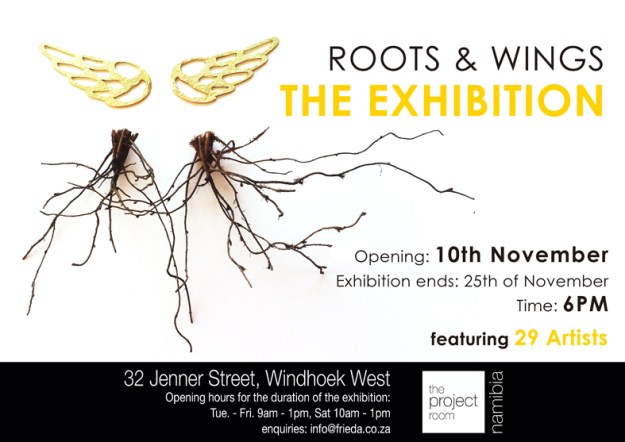
I am excited to be participating in this upcoming group exhibition, together with many other interesting artists! Curated by Frieda Lühl.
Roots & Wings
Come to the opening on the 10th of November (6pm) at the Project Room, to see how different artists have interpreted this theme. Or, if you cannot make it to the opening, the exhibition will be on view till the 25th of November. It is not long, so do not miss it!
Address: 32 Jenner Street, Windhoek West, Namibia.
Opening hours for the duration of the exhibition: Tuesday to Friday: 9am – 1pm, Saturday 10am – 1pm Enquiries: info@frieda.co.za
Unfortunately I will not be present at the opening, but I hope many of you can make it!
Once again nature artists are coming together as part of the Global Nomadic Art Project 2017. This time in Germany, where we will be working in Darmstadt and surrounding area. The theme for this event is ‘Urban Nature Art’.
After participating in last year’s GNAP project in South Africa (Stories of Rain), I am really looking forward to this continuation.
If you are anywhere close, you might want to join us for some of the public events.
Mittwochsform – on the 23rd and the 30th of August respectively. Different artists will present their work. I will be do my presentation on the 23rd of August.
Time: 20h00
Where: Internationales Waldkunstzentrum, 64285 Darmstadt, Ludwigshöhstraße 137
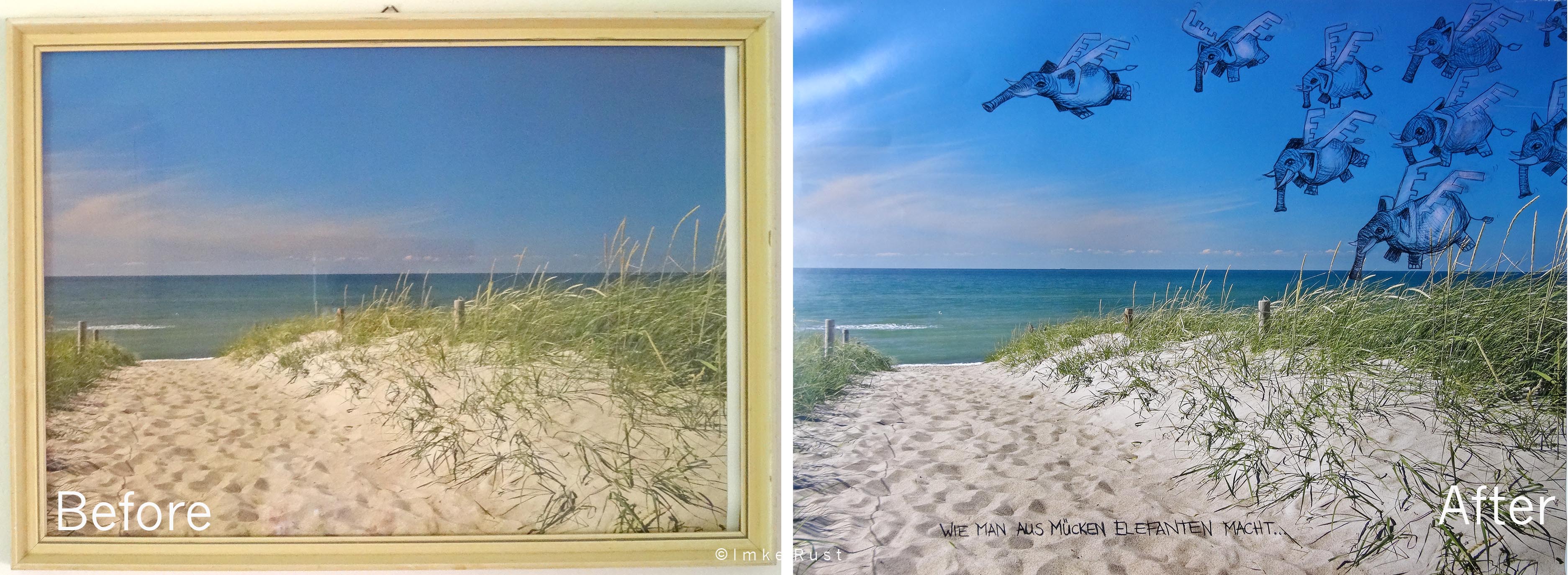
How to make elephants out or mosquitos. (Before and After)
A friend has recently been residing in exactly that holiday flat, where it was made in 2015. He has kindly sent me an update.
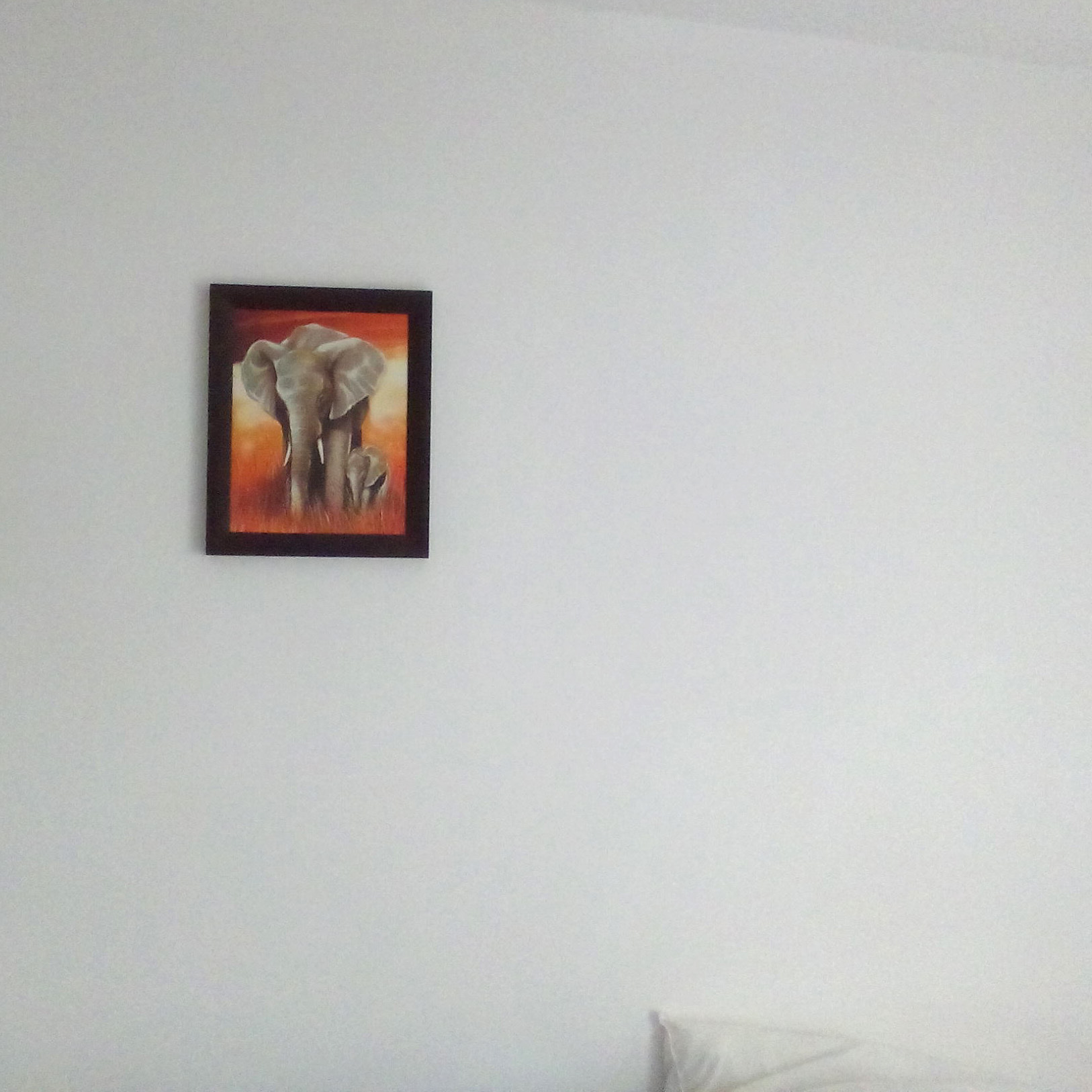
Well, my Mosquito Elephants Intervention has been replaced by a more realistic painterly impression of an elephant and baby….
Elephant with baby (Unknown Artist)
So, now you know.This is how to turn mosquitos into elephants… (even if not real live elephants). My intervention has been noted by the owners. And there has been an improvement from the cut-out calendar page photograph to a ‘commercial painting’. Great!
I am very curious if the choice for the elephant picture was accidential or intentional? And I wonder what they did with my altered artwork? Thrown it away? Kept it?
And…..
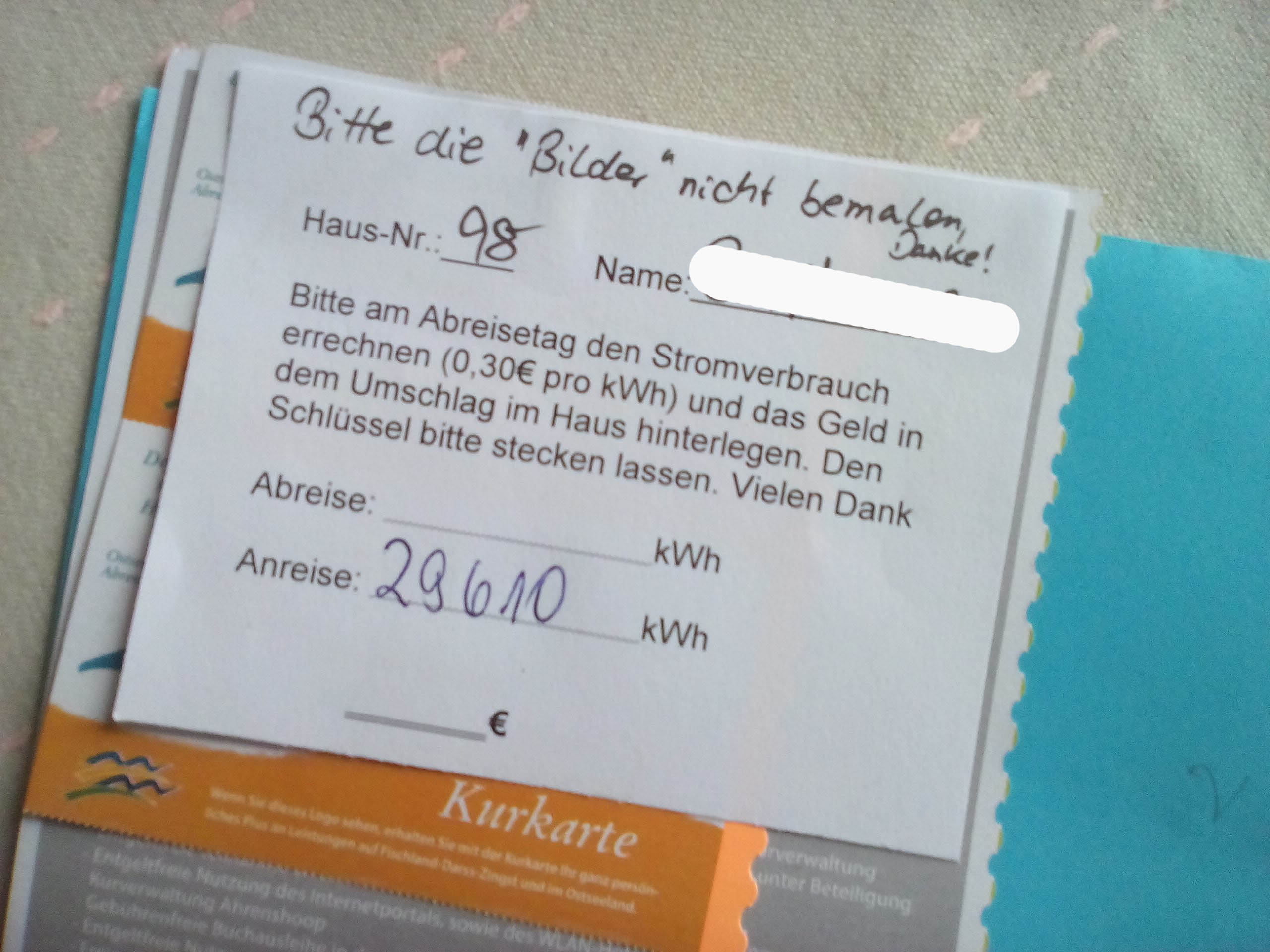
there was a kind hand-written note asking to please do not paint on the ‘pictures’. The German word ‘Bilder’ can be understood either as artwork or as pictures in general. I guess by putting it into hyphens, they have become aware that there is a difference between art and deco.
Kind note: Please do not paint on the ‘pictures’. Thank you!
This all reminds me, that it has been too long since I have been on holiday or spending time in a hotel or holiday apartment for other reasons… 😦
(Scroll down for English) Zu den Tagen des Offenen Ateliers Brandenburg 2017 (6 & 7Mai) werde ich auch die Türen zu meinem Atelier öffnen und lade euch herzlich ein vorbei zu kommen.
Für zwei Tage bin ich ganz für meine Gäste da. Ihr könnt durch meine Arbeit stöbern und sehen wie und wo ich arbeite. Ich freue mich auch auf interessanten und geselligen Austausch und Gespräche. Am Samstag gibt es außerdem noch eine Vorführung von dem Film ‚An Infinite Scream’ über mein Land Art Projekt in Namibia.
Die Tage des Offenen Ateliers sind eine spannende Initiative wo hunderte Künstler in Brandenburg ihre Ateliers öffnen. So kann man sich in diesen Tagen mehrere Ateliers in einer Gegend ansehen. Um einen spanenden Ausflug zu planen, könnt ihr in dieser Broschüre Offene Ateliers 2017 Brandenburg sehen, welche anderen Künstler in der Gegend mitmachen. (Oranienburg ist auf Seiten 56-58 zu finden.)
Ich freue mich auf euern Besuch!
Diese Einladung darf gerne geteilt werden.
Offene Ateliers Brandenburg 2017 Imke Rust
Atelier Imke Rust Malerei, Zeichnung, Land Art, Multimedia
Öffnungszeiten:
11-18 Uhr am Sa und So, den 6. und 7. Mai
Samstag, 6. Mai, 17h30: Dokumentarfilm über Imke Rusts Land Art Projekt ‘An Infinite Scream’ in Namibia (Deutsch, 45min)
I am participating in the 2017 Open Studio Days Brandenburg (6 & 7 May) and you are invited!
For two days I am opening the doors to my studio to the public, so that you can get see where and how I am working, browse through my artworks and enjoy a chat with me. On Saturday evening we will also screen the documentary film ‘An Infinite Scream’ about my Land Art project in Namibia.
The Open Studio Days are a great initiative where hundred of artists in Brandenburg are opening their studios and you can plan an excursion for the day, visiting several different artists in the area. Have a look at who else is opening their studios in our area to plan your day in this brochure Offene Ateliers 2017 Brandenburg (Page 56-58 shows the artists in Oranienburg).
I am looking forward to welcoming you in my studio!
Do you also have the feeling that your life has become so busy, that you have no time for all the stuff you want to do? Or to read all the blogs you are subscribed to?
The first quarter of the year is almost passed and somehow I have neglected my blog. Well, many things are happening and keeping me busy – which is mostly good news. Another reason is that with so many things, which are happening on all fronts (personal, family, political, career etc), I am left with so many impressions, thoughts, ideas, questions… It feels as if I have so much to say and to share, and yet I do not know where to start. It feels as if I would need another lifetime to sort all ideas and find the right way to share them. Or a personal assistant… Or a way to magically write down all that is in my mind within a few hours.
So I am trying to navigate these times, which feel chaotic and alive, terrifying and promising at the same time, as best and honestly as I can. To live each moment more consciously and deliberately waiting to find clarity, allowing life to unfold its plan at its own pace. I am considering writing shorter, but more frequent blogs… let’s see if that is a better way to deal with my and your busy life and still stay in touch.
A quick update:
My exhibition in Munich has just finished. It was very well visited and the highlight was, that a friend has organised for me to fly to Munich and talk about my art to interested guests in a guided tour of my exhibition. I really enjoy that direct contact with the people who are interested my art. Most of my art is filled with layers of meaning and thoughts, and people have commented how enriching they find to look at the art, and then additionally hear me talk about it.
Here are a few impressions from the exhibition and the guided tour (Click on the images for a larger view and description):
In front of the work ‘The Horse is a Problem. The Horse Must Go.’
Being introduced by Carola von Maltzahn
Talking about the artworks ‘Götterdämmerung’ (above left), Promises of Death (below left) and Digging up Old Bones (right).
3 works from the Farm Life series.
Land Art works from ‘An Infinite Scream’
Power Play (Brothers & Sistahs)
Exhibition View
The event has been organized by Carola von Maltzahn from http://www.vonmaltzahn.net/ and Christian Bräuer from Art Dine & Table – Die Kunstpatrouille (www.christian-braeuer.de) Photos: Carola von Maltzahn.
I had another exhibition opening in March, at the Museum auf der Hardt, Wuppertal.
The exhibition and screening of the documentary film about my land art project ‘An Infinite Scream’ was part of a Symposium organized by the Vereinte Evangelische Mission.
Here are some images from the exhibition, opening and film screening. Photos by Ramona Hedtmann, VEM and myself.
What Will be Left (Tourist Map with all currently awarded Exclusive Prospecting licenses cut out)
Dorob (NOT)4Sale
Concession Areas (Top and middle) and ‘Repeating the Same Mistakes (Modern Maharero)’
Archival photograph from colonial times
Repeating the Same Mistakes (Modern Maharero) – an artwork commenting on selling off land and rights for immideatey gain and power.
Introduction by Ms Julia Besten and Mr Uli Baege from VEM
Speaking about my art
Guests getting ready for the screening of the documentary film ‘An Infinite Scream’
Talking to guests
Exhibition view
Art works from my Land Art project ‘An Infinite Scream’
the official photo with my artwork
The symposium included presentations and discussions, and I was very happy and honoured to meet the main speaker, Mr Henning Melber (right)
Only shortly before the event, I realised that I have a much deeper connection to this museum and place than I could have imagined. My Great-Great-Grandfather Eduard Dannert and Great-Grandfather August Kuhlmann were both missionaries in Namibia and were sent by this very same institution to Africa. Needless to say, the museum and archives have lots of information, documentation and objects from these ancestors of mine, like for instance the sewing machine of my Great-Grandmother… and this sewing machine, together with a letter which August Kuhlmann wrote to General von Trotha trying to convince him to treat the Herero people more humanly were exhibited in the same space, next to my political works. What an honour and humbling experience.
Life… This is the sewing machine of my great-grandmother, Elizabeth Kuhlmann. It has been donated to the Museum auf der Hardt in Wuppertal some years ago by a distant relative/aunt. NOW I am going to exhibit in exactly this museum, with my artwork in the same room as my great-grandmother’s sewing machine. Such an unexpected surprise! And weird coincidence to find this connection in Wuppertal.
I have spent 2 days in the archives of the ‘Vereinte Evangelishe Mission’ who have a vast amount of old documents from the missionary activities in Namibia (amongst others). I could page through hundreds of letters and reports written by my great-great-grandfather, my grand-father and some from their wifes. So interesting and informative. I have been so grateful for the people who have already researched and typed some of the information, as the old German lettering and handwriting is damn difficult to decipher. Seeing history through the eyes of my own ancestors is so helpful and interesting, giving a very personal account of how they saw the world and how and why they acted the way they did. I feel blessed to have so much information about my ancestors, not only within the family, but also, additionally in well-organized and accessible archives. And I could see that my ancestors already questioned what was happening and tried to get involved as best they can, given their circumstances. Missionary August Kuhlmann (my great-grandfather) wrote several letters to von Trotha and von Lindequist, pleading and arguing for a more humane and fair treatment of the Herero people. This photo is from one such letter displayed in the museum currently.
My ancestors who first came to southwest Africa in 1874. Missionary Dannert and his wife Auguste (Dahl) and a daughter. The curator Museum auf der Hardt has decided to add some links from the archives related to my ancestors to the exhibition. Like this photo. I notice the love of cats goes back a few generations.
If you happen to be in Wuppertal, you are welcome to view the exhibition. It is still on till the 4th of April. More information, directions and opening times: http://www.vemission.org/museumarchive.html
I am so excited that spring seems to have finally arrived! After so much political art and talk, I felt like painting something light and colourful, to welcome spring.
PRESSEMITTEILUNG / PRESS RELEASE
(For information in German, please scroll down)
If you are in Munich, you soon have a chance to view a large series of my work under the title: The Horse is a Problem. The Horse Must Go. It will be exhibited in the Pasinger Fabrik, as part of a large event organized by the German- Namibian Association (DNG). They will also show their documentative traveling exhibition about the work they are doing and landscape photography by Helmuth Gries. The program entails even more, such as a podiumdiscussion with the Namibian Ambassador to Germany and Namibian movie nights. The exhibition will be opened on the 9th of February and will run till the 26th of March.
If you would like more information in English, please contact me.
Dokumentation – Fotografie – Malerei – Objekte
10.02. – 26.03.2017
Vernissage: 09.02.2017, 19.00 Uhr
Eröffnung durch den Botschafter der Republik Namibia Andreas Guibeb
10.02.2017 19.00 Uhr Podiumsdiskussion mit dem Botschafter der Republik Namibia Andreas Guibeb und Andreas Herbig, Vertreter der Deutsch-Namibischen Gesellschaft
26.03.2017, 18.00 Uhr Kuratorenführung mit Andreas Herbig, Vertreter der Deutsch-Namibischen Gesellschaft
Imke Rust: The Horse is a Problem. The Horse Must Go.
Imke Rusts Arbeiten zeigen kein gewöhnliches Namibiabild. Die gebürtige deutsch-Namibierin drückt durch ihre vielseitige und eigenwillige Bildsprache ihre eigene komplexe Beziehung zu ihrem Heimatland aus. Sie kratzt an der oberflächlichen ‚Postkarten’ Wahrnehmung und hinterfragt und kommentiert auf ihre individuelle Weise die Vergangenheit und Gegenwart Namibias. In ihren Arbeiten sind das Persönliche, das Politische und Existentielle untrennbar miteinander verknüpft. So unterschiedlich wie ihre Beobachtungen ist auch ihre Ausdrucksweise: mal leicht, mal kräftig. Humorvoll und dann wieder aufschreckend ernst führt sie uns durch ihre Welt.
Die Land Art und multimediale Künstlerin Imke Rust pendelt seit sechs Jahren zwischen ihrer Heimat Namibia und Deutschland, zwischen Wüste und Wald. An der Universität von Südafrika absolvierte sie ihr BA-Degree in Visual Art und ist zweimalige Gewinnerin des wichtigsten Kunstpreises Namibias, der Standard Bank Namibia Biennale. In zahlreichen Solo- und Gruppenausstellungen wurden ihre Arbeiten weltweit ausgestellt. Über ein Stipendium des Deutschen Akademischen Austauschdienstes (DAAD) kam sie 2006 das erste Mal nach Berlin.
Namibia und Deutschland – Aktuelle Aspekte einer besonderen Beziehung
Namibia – ein Land, das nicht nur auf Grund seiner atemberaubenden Landschaften und Tierwelt, sondern auch wegen seiner politischen Stabilität ein sehr beliebtes Reiseziel der Deutschen ist. Seit der Unabhängigkeit im März 1990 festigen Beschlüsse des Deutschen Bundestages das Sonderverhältnis beider Länder. Die bilateralen Beziehungen werden an Beispielen aus Politik, Gesellschaft, Wissenschaft, Kultur und Tourismus in dieser Ausstellung veranschaulicht.
Die Wanderausstellung ist ein Projekt der Deutsch-Namibischen Gesellschaft (DNG), die auf eine fast 40-jährige Arbeit im Zusammenspiel Namibias und Deutschland zurück blicken kann. Die DNG unterstützt Projekte in Namibia und fördert den Jugend- und Kulturaustausch.
In der gezeigten Wanderausstellung werden das Land Namibia und seine engen vielfältigen Beziehungen zu Deutschland gezeigt.
Der Betrachter erfährt in der Ausstellung Wissenswertes über die Geographie, die faszinierende Geologie, Flora und Fauna, die Bevölkerung, die Gesellschaft und die aktuellen politischen Gegebenheiten. In einem kleinen historischen Teil wird der Werdegang vom deutschen Schutzgebiet zum heutigen Staat Namibia gezeigt, in dem Deutsch unter anderen immer noch eine anerkannte Sprache ist.
Helmut Gries, geb. 1955 in Deutschland und Fotograf vor allem für Naturbilder, hat vor 20 Jahren Namibia für sich entdeckt und für die Ausstellung in der Pasinger Fabrik eine Auswahl mit unterschiedlichsten Aspekten des Landes zusammengestellt.
Fasziniert von Land, Leuten und Natur bereist er den „Diamanten Afrikas“ inzwischen regelmäßig. Auf 36 Reisen hat er inzwischen mehr als 100.000 km mit dem Auto zurückgelegt, viele Flugkilometer in entlegene Regionen mit Kleinflugzeugen absolviert, die zentrale Bergwelt auf dem Rücken eines Dromedars erkundet und die wasserreichen Gebiete entlang der Grenzen zu Angola und Botswana in Booten durchstreift. Ausgedehnte Wanderungen haben ihn mehrfach in den Fish River Canyon und in die Weiten der Wüste Namib geführt, die er 2015 zu Fuß vom Sossusvlei bis zum Atlantischen Ozean durchquert hat.
Sein Fotoarchiv über Landschaften, Tiere und Menschen umfasst Zehntausende von Aufnahmen. Die Motive lichtet er mit digitalen Spiegelreflexkameras von Nikon und Objektiven von Nikon und Sigma mit Brennweiten zwischen 10 mm und 600 mm ab. Seine eindrucksvollen Fotografien werden neben einem seit 2001 jährlich erscheinenden Fotokalender, in Magazinen und Reisekatalogen sowie auf Postkarten und Websites veröffentlicht. Inzwischen sind auch zwei Bildbände über den Süden und den Norden Namibias erschienen. Im Rahmen seiner Aktivitäten in der Deutsch-Namibischen Gesellschaft e.V. stellt Helmut Gries das faszinierende Land im Südwesten Afrikas regelmäßig in Audiovisionsshows vor.
Weitere Informationen:
Thomas Linsmayer
Ausstellungsleitung/Verwaltung
Pasinger Fabrik Kultur- und Bürgerzentrum GmbH
Eine Einrichtung der Landeshauptstadt München
August-Exter-Straße 1
D 81245 München
Tel +49 (0)89 829290 -13
Fax +49 (0)89 829290 -99
t.linsmayer@pasinger-fabrik.com
Travelling by ferry with some of the participating artists on a cold and rainy day.
Finally… I am making the time to share with you the fruits of my time in South Africa as an invited participant of the Global Nomadic Art Project 2016 South Africa. I had such a rich and productive time there, that I slightly shied away from writing about it – I just did not know where to start.
The GNAP ‘Stories of Rain’ Art Project was an incredible journey through South Africa’s landscapes, myths and lively land art scene. Very well organized and carefully planed, we were treated to so many different places, warm hospitality, creative time in nature and an exciting selection of fellow artists. I appreciated the constantly changing small groups in which we travelled. They enabled us to meet so many local and international artists, exchange ideas and create together in a very unique way. Thank you to the GNAP team for this very special platform and project and thank you to all the many South African organizers, especially Strijdom van der Merwe and Anni Snyman, who made the South African leg of the journey such a memorable one!
I have decided to split all my artworks into smaller groups and introduce them to you in separate blog posts. Trying to keep each one short and sweet, but still let you in on my ideas and thoughts as much as possible.
During the ‚Stories of Rain’ Art Project I continued with my rainmaker project and research. Can we create rain through a conscious and intentional creative process? I have used the surrounding landscapes and materials to explore different ideas from creating clouds out of stones or mud, performing a cloud dance and working with the idea of female tears being conducive to calling the rain.
First I will share with you one of my more familiar looking rainmaker works:
The final Rainmaker Cloud, Porcupine Hills made with earth pigment
In the following gallery I will share with you the story of how I created this artwork and rainmaker and show prove of the rain that followed. (Click to see larger versions of the images)
Collecting red pigment from the earth
Grinding pigments for my artwork
Making paint from earth pigments
Learning new skills, from Cha Davenport, our wonderful host and fellow artist. Together with Chris Lochner (botanical artist)
Painting on a rock on a very steep rockface
Close-up
Finally an offering of water to give thanks for the coming rain.
Close up of the water wetting the rock, lichen and small plants.
Me and the finished rainmaker cloud.
The final Rainmaker Cloud, Porcupine Hills made with earth pigment
First clouds appearing on the blue sky
Porcupine Hills – a beautiful place to stay – View from the Rainmaker Cloud towards our accommodation
Inspiration for the clay pigment painting coming from the walls of the Porcupine Hills guest farm.
Porcupine Hills – a beautiful place to stay
The rain always came, perfectly timed, when we were on the road again… here is the photo prove.
The rain always came, perfectly timed, when we were on the road again… here is the photo prove with a rainbow.
I loved the stay here! Thank you to our hosts Cha and Tony Davenport are such wonderful people and made us feel perfectly at home. The place is great – recommending it fully if you would like to break away from the city for a weekend or longer!
Porcupine Hills offers self-catering guest accommodation and boutique olive oil. Close to Cape Town (100km) but a world away from city and suburban life. This is the perfect place to escape into nature and spend time in a quiet, tranquil and beautiful space.
The underlying farm “Diepklowe” is a Private Nature Reserve within the van der Stel Cluster (four neighbouring conservation farms) and is designated as a Cape Nature Stewardship Programme area. It is a core member of the Groenlandberg Conservancy.
The farm was acquired in 2012 by Tony and Cha Davenport and their two sons, Justin and Tobin.
Finally I can move my work space out of our living room and into the new renovated garage / studio space.
Suddenly we have space in the living room and are now looking for a nice couch which can double up as a guest bed. Ideally a couch needs to look good, be practical and it definitely needs to be ultra comfortable…
This morning when I started working and was looking for some images, I came across a spontaneous and fun ‘preformed photography action’* I did some time ago in a holiday flat, and decided to turn the photographs into a GIF (moving image).
Couch Testing by Imke Rust
Wishing you all a wonderful and comfortable day!
* Sometimes it is difficult to perfectly describe my art. I hope this term comes close, but am not sure. Often I do a performance kind of work, but without an audience. I document it through photographs or video. Yet the action is the central part and the photography just a way to share it with you. So it is neither pure photography, nor a performance in its original definition.
(*a woman, or a force personified as a woman, who is the source of inspiration)
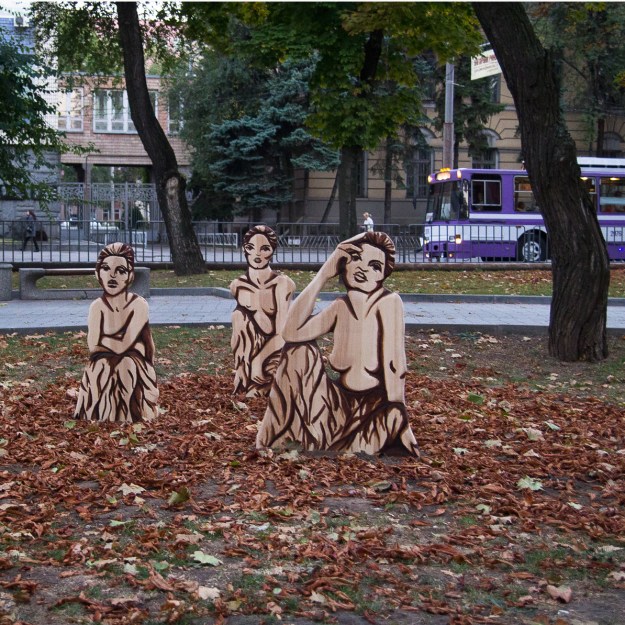
Finally I am back in Germany and need to catch up on so much news to share with you! So, without further ado, I jump in with news from the Ukraine: On the 28th of September (while I was busy creating land art in South Africa) my public sculpture project “Three Young Muses” has been unveiled in Dnipro City.
I was invited by the German Consulate of Donezk and Artsvit Gallery to create a public artwork as a gift to the city. It was a challenging project, due to several logistical, time, budget and planning constraints, but with such a great team working together it all was successfully completed in time for the German Weeks. The artwork was installed opposite of the Yavornytsky National Historical Museum.
Three Young Muses, Art project of Artsvit Gallery and German Consulate of Donezk. Artist: Imke Rust
The Three Young Muses have been installed here to create a direct visual and conceptual link to the ancient Baba figurines. They are three young, modern-day women who relax on the grass of the park and contemplate the future.
In dialog with the ancient Babas, these young Muses hope to inspire modern society to re-embrace the female wisdom and power in order to balance the male and female energies in society. They also remind us that our generations are responsible to consciously envision and co-create our future.
Unlike their ancient stone counterparts, the Three Young Muses are made out of ash wood. Their wooden nature is symbolic for life, growth and transformation. The wood’s vulnerability and semi-permanent nature also represents our fast-paced modern times and reminds us to live in the present moment, as reality changes faster than ever. By focussing on the Now we have the power to determine and shape the future according to our highest vision. If you would like to know more about my thoughts behind this work, I have added some at the bottom.
A short video documentation about the Three Young Muses Art Project Video: Serge Ostrianyn, With the kind permission of Artsvit Gallery
I would like to thank the German consul Mr Mössinger and the team of the German Consulate of Donezk, Ms Iryna Polikarchuk, Director of the Artsvit Gallery and her team and the City of Dnipro for this opportunity. Also thank you to Bazarenko Yuriy (Architect), Serge Ostrianyn (Video), Vita Popova (Photos), Nikita Shalenny (Studio space) and Liosha (Assistance).
Some pictures (click on images to see a larger view):
Imke Rust working on the Three Young Muses
Finishing touches
Imke Rust with the Three Young Muses in the studio.
Installing the bases
Insatllation of the 3 figures
Still hidden from view.
German Consulate Mr and Mrs Mössinger and Iryna Polikarchuk, Director Artsvit Gallery
Ms Iryna Polikarchuk, Director Artsvit Gallery, giving a TV Interview with the Baba Figures in the background
The Three Young Muses
More Info regarding the background of the Three Young Muses (if you are interested in the nitty-gritty details 😉 ):
Cooperation / Together we are stronger.
They are a small group of three women, named: Love, Hope and Gratitude. I believe that these three qualities are essential to our peaceful future.
The three women are also symbolic of the three backgrounds coming together in the creation of the sculpture through a German- Namibian artist creating in the Ukraine. Together we are stronger and the more we understand that there are no differences between people, no matter where they come from or who they are, the easier we can co-exist and co-create a better future for all. Each lady is symbolical for one of the three countries connected here: Ukraine, Germany and Namibia.
Three:
The third dimension – we do things in threes so they will manifest in our physical realm.
It’s roots stem from the meaning of multiplicity. Creative power; growth. Three is a moving forward of energy, overcoming duality, expression, manifestation and synthesis. Three is the first number to which the meaning “all” was given. It is The Triad, being the number of the whole as it contains the beginning, a middle and an end.
The power of three is universal. Body, mind and soul. Birth, life and death. Heaven, earth and hell. Three is a complete cycle unto itself. It is past, present, future.
There are three wishes, and in many fairytales there are three sisters…
Past, Present and Future
The Babas look towards the Three Young Muses and put their hope and expectations into the young generation, especially the women, to get engaged and empowered to change our destiny.
The viewer, when passing the Three Young Muses on the park walkway, will be located between the past (Babas) and the future (Three Young Muses), and will become the link, the present moment, which shapes our future. I hope that we learn from the past, but look towards the future.
Size and Material
The Three Young Muses are created only slightly larger than real-life women. I hope this invites people to engage on eye-level with the artwork and ideas behind it. Possibly to sit between or around these figures and get inspired…
I believe that unlike older, monumental public sculptures, which create a distance to the viewer, contemporary art should be more interactive and accessible. The size and the vulnerable material highlight these ideas.
When faced with the obvious ‘weakness’ of the material, the responsibility to treat these figures with respect and care now lies with each member of the public. It will be interesting to see, if and how people ‘accept this challenge’ of openly displayed vulnerability. Will they be treated according to our inherent deep-seated values towards women, art or public property? Can we trust each other with our vulnerability? Do we let ourselves be inspired by their openness, confidence and soft strength that these Muses display?
The choice of wood (symbolism of the Ash tree):
According to different sources that I found on the Internet, Ash wood is a symbol of healing and especially transformation and empowerment in matters of destiny.
It is also considered to be “the key to healing the loneliness of the human spirit, forming a link between the gods, humans, and the dead in the spirit world. Ash holds the key to Universal Truth and Cosmic Wisdom, and it takes on the important role as a Tree of Initiation.”
Relation to and inspiration by the stone Babas:
The specific form in which the Three Young Muses were conceptualised has been inspired by the Baba figures, of which I have read:
“A widespread form of sculptures were steles of a simplified anthropomorphic type that were formed of flat right-angled stone plates. Their lower part was not worked as it was meant to be dug into the ground, though they had carefully shaped shoulders and heads with well-carved facial characteristics. …
…are Polovtsian (Cuman) stone babas. There are about two thousand of them left. They are usually found in groups of 2 – 3 statues on the highest parts of steppe – on the sanctuaries of the funeral cult of ancestors. Polovtsian statues symbolized their ancestors and were not directly connected with the burial ritual.
… At the end of the century a visible simplification of form took place when the back of the statue was not decorated, also the details of haircuts and costumes were missing on the front side.
I am very happy to announce that we have two winners who will receive the 21 Secrets Color! Color! Color! Workshop package.
I made a list of all the old subscribers (who wanted to participate) and new subscribers. This morning I was happy to have Patrick Tagoe-Turkson, an artist from Ghana who currently is on the Global Nomadic Art Project with me in South Africa, to name me two lucky numbers, so that I have a totally impartial selection.
So, without further ado I can now announce the lucky two people who will hopefully soon spend their time emerged in colour and creativity and learning lots of new information and techniques.
The winners are Number 6 and 9, which translates to:
Drumroll….
Renate N. and Jackie B.
Congrats, I hope you will enjoy your workshop!
For everybody else, I am so sorry that you did not get the free workshop package, but you can still buy it by clicking on the 21 Secrets Image on the right-hand side column of this blog, or click here.
(The winners have been notified per email.)
Click on image to find out more or buy the workshop.

 I am excited to be participating in this upcoming group exhibition, together with many other interesting artists! Curated by Frieda Lühl.


![FullSizeRender[13]](https://i0.wp.com/imkerust.com/wp-content/uploads/2017/03/fullsizerender13.jpg?w=415&h=312&ssl=1 "FullSizeRender[13]")
![FullSizeRender[18]](https://i0.wp.com/imkerust.com/wp-content/uploads/2017/03/fullsizerender18.jpg?w=320&h=206&ssl=1 "FullSizeRender[18]")
![FullSizeRender[20]](https://i0.wp.com/imkerust.com/wp-content/uploads/2017/03/fullsizerender20.jpg?w=297&h=206&ssl=1 "FullSizeRender[20]")
![FullSizeRender[21]](https://i0.wp.com/imkerust.com/wp-content/uploads/2017/03/fullsizerender21.jpg?w=152&h=98&ssl=1 "FullSizeRender[21]")




 Imke Rust