Category Archives: Land Art

Film Revue: An Infinite Scream

Source: Film Revue: An Infinite Scream

(Sorry to all English subscribers, today I reblog an Afrikaans review about our film which will be screened tomorrow, 14th January, at the Goethe Institut in Windhoek @ 19h15)

En nou vir die van julle wat Afrikaans praat, ‘n Film Revue in Afrikaans van die wonderlike Daniël Bezuidenhout a.k.a Thulana wat met haar woorde en taal kan toor.

Lees gerus ook ‘n bietjie van haar ander blog posts, so mooi geskryf met ‘n wonderlike sin vir humor en interessante stories oor haar lewe in Ghana.

Dankie Daniël!

“Elkeen van ons wat soos ‘n volstruis met sy kop in die sand staan, en vertrou die regering sal na al jou belange omsien, moet ‘n slag staan en wonder hoe goed dit uitgewerk het vir die Boesmans.


In ‘n aangrypende artistiese dokumentêr, “An Infinite Scream”, kry die Imke Rust jou kop uit die sand. …lees meer hier

Finally! A new year, a new blog post and an important event to announce!

Firstly I wish you all a very happy, adventurous, creative, healthy and awesome 2016!

I hope this will be the year where you make your dreams come true, create the reality that you want to see and find joy and gratitude in your everyday life. That is my motto, not only for the New Year, but for every new day. And added to that, I want to push myself every day to creatively and fearlessly express who I am. How about you? What are your visions and desires for 2016?

I have been quiet on the blog for some time… I am spending time at home in Namibia, with my family, meeting friends, relaxing and creating. Basically replenishing my soul and soaking up the sunshine, warmth and familiarity of home.

Clarissa, my cat, inspecting the last painting I have done in 2015 - an impression of a wild mongoose who visits us daily.

Clarissa, my cat, inspecting the last painting I have done in 2015 – an impression of a wild mongoose who visits us daily.

Home. Returning to Namibia after almost two years of absence has stirred my mind and body in interesting ways. I realise that finally our house in Germany feels more like a home to me, while Namibia and my family home here, where I have spend so many years of my life, has moved into an uneasy place of feeling powerfully familiar and at the same time somewhat distanced. Things have changed, things have stayed the same. I have changed and grown. I am curious to see how my life and I will evolve in the future.

You can view some of my everyday impressions from Namibia on my instagram account: https://www.instagram.com/imkerust/

And as promised an event announcement:

Finally we will be presenting ‘An Infinite Scream’ – my husband, Steffen Holzkamp’s documentary film about my land art project – in Namibia! On home turf so to say.

It took some time before Namibians can finally see the film and obviously I am curious and nervous as to how it will be received. So I (and Steffen) hope that if you are in Windhoek on the 14th of January you will join us at 19h15 at the Goethe Institut. (it is FREE!!!)

By the way, Namibia only had a Goethe Centre up till now, but since 2016 everybody is very excited to have it turned into a Goethe Institut. We feel very honoured that one of the first official events in the new Institut will the Namibian Premiere of our film.

Why would you see the film? Well, if you are interested in nature, environment, the desert, Namibia and/or the arts, or if you simply like me or what I am doing, then this film offers you a unique and thought-provoking view. Some serious and some fun.

It is more than a documentary.

It is an artist portrait and a project portrait. It is a reflection on what individuals can do to make the world a slightly better place. It is a beautiful mix of art, nature, society and action…

Most people only ever see the final exhibition and have no idea how it came about. If you have ever wondered how artists think, why and how they create and all the things that happen behind the scene, before you get to sip your wine at the exhibition opening, this film will give you a lot of insight into my personal way of creating.

I know I might be biased in more than one way, but I do think there is a certain magic happening when you have a very talented filmmaker and musician, who happens to know you well enough to perfectly reflect your ideas and works through his film.

This film was not planned to be a film. When I started out with my work, I simply thought it would be awesome to have the making of the individual pieces documented and fortunately Steffen was happy to do that for me. Only later, when the exhibition finally happened, after the original venue had suddenly rejected it, Steffen had the idea to turn all his filmed material into a documentary… and spend about a year on this labour of love. Thank you so much, Steffen, for all your hard work and dedication, for your beautiful pictures, music and your vision to pull this all together.

So if you are curious, we warmly invite you to come and see it.

It is not only free of charge, but you also get the chance to meet up with us and ask us questions afterwards 🙂

We are looking forward to meeting you there.

Please also feel free to share this information and invite your friends along. After all, the more the merrier.

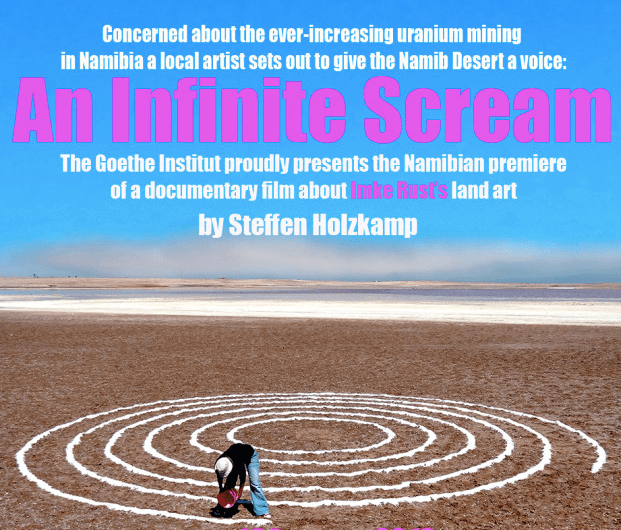
Namibia Premiere: An Infinite Scream (Poster)

Namibia Premiere: An Infinite Scream (Poster)

Concerned about the ever-increasing uranium mining in Namibia a local artist sets out to give the Namib Desert a voice: An Infinite Scream

The Goethe Institut proudly presents the Namibian Premiere of a documentary film about Imke Rust’s land art by Steffen Holzkamp.

Date: 14th of January 2016
Time: 19h15 (Duration: 45min)
Venue: Goethe Institut, 1-5 Fidel Castro Street
Free Entry
Artist and filmmaker are present.

Trailer and more info at: https://aninfinitescream.wordpress.com/


Interview about my Environmental Art

Some time ago I was approached to have some of my artworks published in a book, entitled ‘Temperatures Rising – Climate Change in Africa – a Journey in Pictures’. The book will be produced for the United Nations Economic Commission for Africa (UNECA) to be presented to the delegates and guests of the COP21 conference next week.

The consultant responsible for the book, Ms Asieh L Nassehi Javan of Concept2art in Torino, Italy, asked me to submit several suitable artworks of mine and has interviewed me about my art. One artwork was selected for illustration of the book, while it will also be printed as a poster to be presented in the African Pavillion. I am so honoured and excited!

I thought you might enjoy reading the interview and get to know more about my ideas behind my art, so I am sharing it with you here:

ANJ: What is the role of an artist? As an educator? As someone who makes people aware of issues? A critique? An agent of change?

IR: All of these. I believe different artists have different and often several roles, which together shape our (human) identity and future.

Personally I see my role in offering an alternative perspective on the world and our perceived reality, and offer possible creative solutions to problems affecting us. Part visionary and part agent of change. A little bit like the shaman or rainmakers in old cultures, who through their ritual and creative expression raise awareness and envision and enact a new, better reality.

ANJ: How do you define your art? 

IR: I work in a wide range of media, dependent of the concept or vision for the artwork. My work cannot be defined by putting it into a box. Roughly I would say it is a mix between creative, visual expression, alchemy, magic and spirituality, often with a sprinkle of playfulness.

It is a flowing process between all these layers, always conscious about trying to make a positive impact and slightly changing our perceived reality.

ANJ: What inspires you to create works that address hurting the Environment/Climate change? 

IR: My works usually starts when I notice something, which stirs me emotionally. Often these are situations which I find frustrating or problematic, so I start to wonder what could be changed and how.

Namibia is a dry country with two large deserts. We are extremely dependent on rain for survival, but also on managing our natural resources well. I try to find different ways to feel less helpless when it either does not rain or when I see great damage being done to our environment. I love researching and experimenting with really alternative ideas, because I believe often the mainstream ideas are what brought us the problems in the first place.

As an artist, my purpose is to use my art to make the world a better place. Others have different purposes. Like my father, who is a farmer and an engineer, so he tries to find agricultural ways to positively impact the environment, for instance through Holistic Resource Management. I learned much from him, but was also frustrated, that still we are dependent on the rain and that rainfall cannot be controlled. So I ask myself is this true? Why does almost every ancient culture across the world a belief in a rainmaker or a rain dance? And how could I combine my art, my knowledge and research and my spiritual beliefs to at least consider the possibility of having an impact on the rainfall?

ANJ: Is there an experience, instance or event that led you to create works about the environment?

IR: As an art student I had no money for art materials and usually in Namibia traditional art materials were either not available or extremely expensive. So I started to look around to find alternative materials to use, which I could gather for free.

So early on I noticed the abundance and usefulness of the environment for my art. Through that, and the fact that I grew up on a farm, it was a natural next step to pay closer attention to the environment and realize our connection to it more deeply.

My artworks from the series ‘…and I sensed an infinite scream passing through the Namib’ started from seeing the increased damage of more and more uranium mines and connected industries on the environment. Other people were demonstrating to stop the mines and I asked myself how I could personally contribute, since demonstrating was not my thing. I looked for ways in which I could address the problem and create solutions in my own way.

ANJ: Can you elaborate on the art works you are submitting? What are the messages they aim to send and to whom are the messages directed?

IR:  Rainmaker:

Rainmaker (Masking Tape on Rock, temporary intervention)

Rainmaker (Masking Tape on Rock, temporary intervention)

All over the world the old cultures had shamans who were known to be able to create rain, either through dance, music or rock-paintings. From my research I construed that the creative act combined with a focused intention can create a different energy or vibe and thus change the perceived reality.

Since then I have experimented with different methods of using my art to hopefully ‘make rain’. This specific work creates a vision of the reality we intend to see, in a similar way that the old inhabitants of Namibia would have used to attract animals for a good hunt. I have made several different artworks or experiments researching different approaches.

The message is two-fold: it tries to remind people to focus on the rain and not the drought, and secondly open people up to the idea, that there may possibly be alternative ways to see the world and to impact the reality around us. I cannot say for sure this way does work, but by trying it out, I hope it encourages other people to also try out alternative ideas, even though they might appear silly or ridicules. Through actively taking charge, and playfully experimenting with different things, we might find new solutions. (Find out more about my rainmaker experiments by clicking here.)


Earth Woman:

Desertification and erosion in Namibia is becoming an increasing threat, which is to a large extend a result of us not taking proper care of the environment. I found these deep erosion cracks and I wanted to use the human, female body and the naked skin to highlight this problem and to make us aware that the soil of the earth is like our skin and equally vulnerable and in need of care and attention.

We are intimately connected to the soil and our destiny is so closely linked to that of our environment. These works allure to this and the birth, life and death cycle, which starts and ends with the earth. ( For more work from this series, click here. )

Works like the Tokoloshe Trap acts in my usual multi-layered way. It tries to use the spiritual intention and activated energy, the shapes and material to protect the land in a spiritual way, but it also lets people see a familiar environment in a different and unexpected way. I hope this will let them pause and become more aware, start wondering and asking questions. I also hope it works via a physical experience: any Namibian knows from personal experience how painful it is to step into one of those thorns. Seeing so many of them arranged as a kind of trap, usually lets us cringe, while we imagine stepping into it. (More about this artwork: click here)

An Infinite Scream

In this documented performance-like action I asked passers-by to re-enact the famous painting ‘The Scream’ from Edvard Munch, on the Swakopmund jetty. Munch claimed that he sensed the angst and scream of nature, which led to this painting. Be re-enacting this scream, the people give an expression to the fears about the destruction of our environment. The resulting images and video raise awareness in a fun way. (More about this intervention: click here. and to see a super fun short video about it: click here)
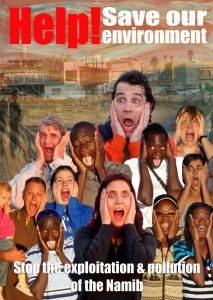
An Infinite Scream Public Intervention

An Infinite Scream Public Intervention

Dorob (NOT) 4Sale

This anonymous intervention used a tongue-in-cheek way to get people’s awareness about the sale-off of our natural resources. Fake estate agent for-sale signs were placed at prominent places along the main roads leading through the Namib desert, with messages that our desert and ocean are (NOT) for sale. The provided telephone number and Web address lead to further information and links to environmental initiatives. (More about this intervention: click here. )


Hand-painted Photographs of the Namib Desert

While I was in Berlin, I heard about the plans to build a large chemical plant in the Namib Desert. I imagined what the desert around that plant would look like, if the waste is not properly managed, like so often before or if something unforeseen happens. I painted these scenarios onto photographs of the desert. Later, when I returned to Namibia I used the ideas from the photos for temporary land-art installations.

Toxic Rocks & Poisonous Water

The neon paints might initially give the landscape a funky and modern look, which is quite pleasing, until we notice that this is not natural and healthy. I hope to make people understand that we have to take a second look and consider the different realities behind a situation. Yes, a chemical plant might bring job opportunities, but also illnesses and destruction to the environment. Only when we consider all aspects, can we make a good choice. What looks pretty at first, might turn out to be nasty in the long-run. (More about this artwork: click here and here.)


AJ: Could your art, even though its related to Africa, reflect the global narrative?

IR: Definitely! When I started off with my career, I thought I am working on personal issues which are directly connected to myself and my home-country. I very soon realized, that once you scratch under the surface, we are all human and have the same hopes and fears. Situations and patterns are so similar all over the world, but we are often too distracted to notice, because we focus on the thin superficial differences.

Not all countries are desert countries, but still we all are exposed to and dependent on our environment. A country with plenty of water also needs to manage their resources. They might not need a rainmaker, but through my artwork they could feel inspired to play with alternative ways of interacting with and caring for their environment, and minimize the danger of floods for example.

ANJ: Do you have any comments you would like to add? 

IR: Thank you so much for your interest in my work and this opportunity to make it visible to more people worldwide.

Imke Rust busy installing 'Poisonous Water'

Imke Rust busy installing ‘Poisonous Water’

Thank you Ms Nassehi Javan for letting me share our interview here! It has been such a pleasure getting to know you and working with you.
You will not believe what I found in the forest…

I decided to go for a spontaneous walk in the forest, because I felt overwhelmed by the emails I had to answer and the admin that I had to do. And I could not think, because my head ached so much.

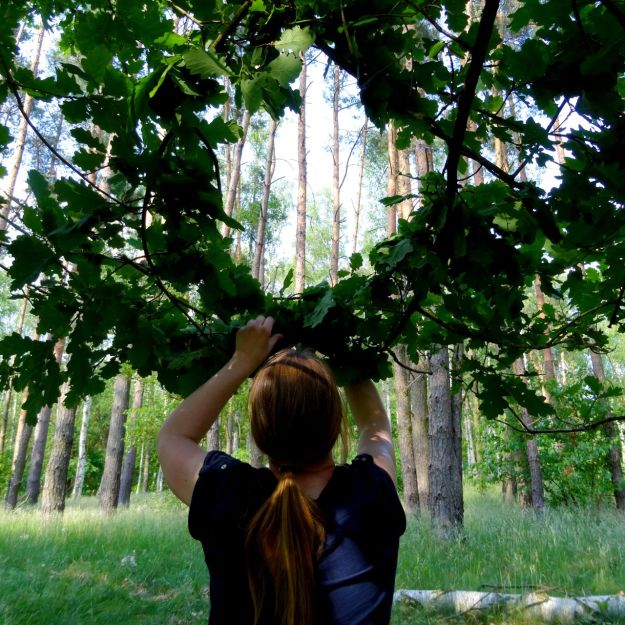
Me in the forest

Me in the forest

I decided to only take my camera and my new summer hat along. And since I longed for a good foot massage, I went barefoot. I love that there are almost no thorns in the area where I live now. Back in Namibia there are so many, small ones which we call ‘dubbeltjies’ and large thorns, for instance from the Camelthorn trees. Going into the bush without shoes would be hell.

The forest ground welcomes you with soft moss. What a delight. Yet there are also broken off branches and pinecones, which can be quite painful when stepped on.

I found that walking barefoot in the forest made me walk slower and take every step with more consciousness. Not only did I get a foot massage, but I was also enjoying the sensations of the different textures beneath my feet. The feeling of being supported by a soft, green carpet made me feel connected and happy.

I found peace, trees and ferns in the forest.

I know, you will think that is nothing special. But it is. On a hectic day, peace is really special. And trees and ferns are too. Especially once you decide to see them, and then be grateful for their presence. They also make wonderful playmates and soul soothers.

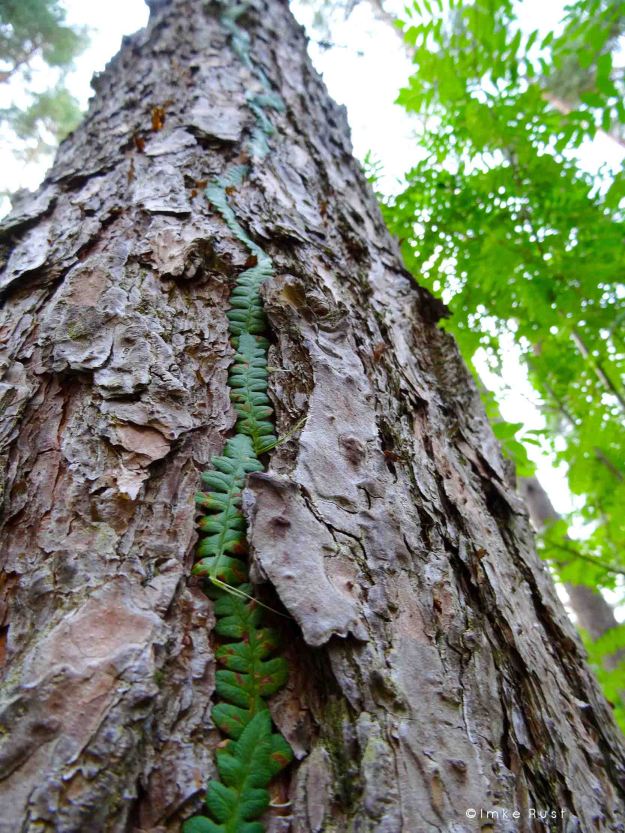
Tree with line of fern leaves

Tree with line of fern leaves

Together we played a silly game and had a good time. We placed small parts of the fern leaves into the bark of a tree to form a line. And yes, just so that you know, I do ask permission and say my gratitude for the donation of the leaves from the fern. Here you can see what we have done.


Detail: Tree with line of fern leaves

Detail: Tree with line of fern leaves

Scrolling up and down the green line on the bark of the tree (the line is about 2m long )

Scrolling up and down the green line on the bark of the tree (the line is about 2m long )

I even made a small video.


Then I found 4 young birch trees, which have been driven over by the forestry vehicle. They were still holding on to their roots and growing, but they were lying flat across the earth, instead of growing upwards. I pulled them up and secured them with each other so that they can grow upwards again. I believe that were grateful and will soon go back to see how they are doing.


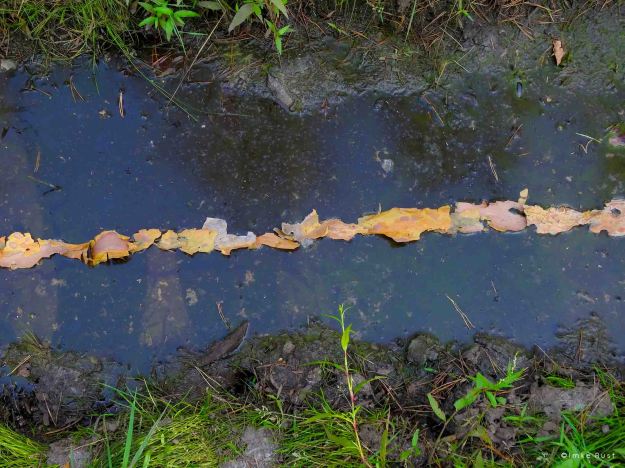
Lastly, I found a dirty puddle of water and the awesome orange peels of bark lying around.

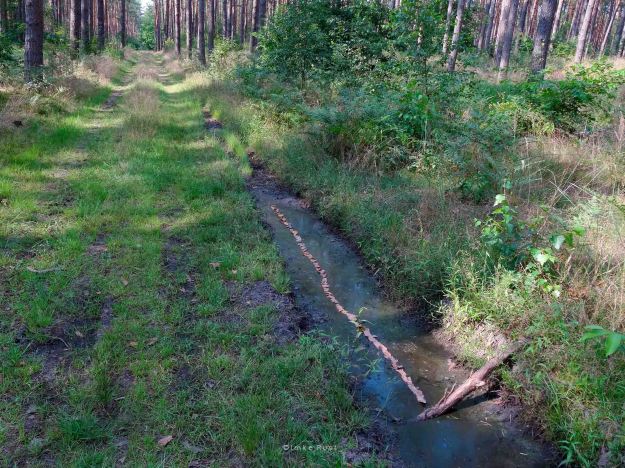
This gave the impulse to one last game I played. I carefully arranged the bark in a long line on the water, taking care that they do not sink in. Suddenly the puddle looked much happier.


Detail view of the Bark Line

Detail view of the Bark Line


Bark Line in puddle of water

Bark Line in puddle of water

When I finished with this, I could even save a beautiful butterfly from drowning in a dirty puddle. 

See the video to get to know my unexpected co-creator:


So, two hours later I got home and felt much better.

I hope that you too have the chance to slip out into nature, every now and then, to get grounded and recharge your batteries.


What you missed last weekend (but can still sign up for in the future)

Yes, you missed an awesome sunny Saturday spent in the forest in a relaxed atmosphere, learning and creating together at the Land Art workshop I presented.Kreativ im Grünen

After a short introduction to the ideas and possibilities of land or nature art, we set out on the short walk to the forest. The area offers a wide variety of different backgrounds and possibilities, ideal for each to find their best mode of expression. There is a small open birch forest, a dense coniferous forest, a meadow and the Havel river…

We had time to get to know the area, the materials available and then experiment with own works. The exchange between the different members of the group brought further ideas and inspiration and lots of laughter, but also serious discussions.

“What a wonderful way to spend the day! I could feel how the stress of the week quickly left my body and I began relaxing into my surroundings. It was great to have no pressure of having to perform, but to be able to experiment and create to my hearts desire. Thank you, Imke.” Ilona.

If you would like to participate at one of our future one-day workshops, which will be presented on a monthly basis, please send me an email, so that I can keep you updated about future dates and send you all other information needed. I am also happy to create tailor-made workshops according to your wishes, for that extra special private birthday party, company outings, a fun family breakaway, etc.

Please email me at: imkerust(a)iway.na (replace the (a) with an @ when sending).

Further information about the workshops can be found HERE. (The information is only available in German at the moment, but I am happy to offer the workshops in English too. Please request the English information sheet directly from me.)

Since pictures say more than a thousand words, I will not write further and rather share some pictures of the workshop with you (click on the images for a full-view slide show):

Berlin Premiere of ‘An Infinite Scream’

We are very excited to announce the Berlin Premiere of the German version of our

documentary film ‘An Infinite Scream’ at the

BrotfabrikKino in Berlin

on Saturday, May 30th (2015)

We hope we can welcome many of you for the very first public screening and a discussion with Steffen Holzkamp (director and producer) and myself, the artist. This is an exciting and intimate look behind the scene of my art making, my intentions behind it and the challenges and opportunities of the art scene in Namibia.

Please feel free to share this event widely with your friends! Thank you.

EinladungEinBild

   Die Deutsch-Namibische Gesellschaft e. V. und der Glashaus e. V.

laden Sie herzlich ein zur

Berlin-Premiere des Dokumentarfilms AN INFINITE SCREAM (Deutsche Fassung)
 
am Samstag, dem 30. Mai 2015

Beginn: 18:00 Uhr
Ort: BrotfabrikKino, Caligariplatz 1, 13086 Berlin-Weißensee
(Tram M2, M13, 12; s. „Service“ unter http://www.brotfabrik-berlin.de)

Programm:

18:00 – 18:45 Uhr        “An Infinite Scream”
18:45 – 19:00 Uhr        Gespräch mit dem Filmemacher Steffen Holzkamp und der Künstlerin Imke Rust
19:00 – 19:40 Uhr        weiteres Filmmaterial zum Thema

Synopsis:

In der prallen Wüstensonne über 1000 Weißdornen zu Kreisen legen? Schwarze Müllsackrosen in die Sanddünen pflanzen? Oder eine halbe Tonne Salz  zu einer begehbaren Skulptur formen?

Die Landart Installationen der Namibischen Künstlerin Imke Rust folgen einem immanenten Anliegen: Der Sorge über den zunehmenden Uranabbau in Namibia und der Verschandelung der Wüste. Ihre Kunstwerke sorgen für Aufmerksamkeit, verstehen sich aber auch als ein symbolischer Schutz für das geschundene Land.

Kann Kunst etwas bewirken? Was kann ich tun? Mit diesen Fragen beschäftigt sich Imke Rust auf eindringliche Weise.

In 2012 in Namibia und Berlin gedreht, spiegelt der Film die  teils meditative Stimmung der Entstehung von Rust’s Landart. Ruhige Einstellungen bei der Installation der „Salt Circles“ oder reportagige Handkamera bei der Videoperformance „The Scream“ auf der Seebrücke am Atlankik: Schnitt und Montage folgen dem Tempo der Kunst.

Die Absage der gebuchten Rust-Ausstellung seitens der Kunstvereinigung bringt dem Film eine dramaturgische Wendung und verlagert den Schwerpunkt hin zu einer gesellschaftlichen und medialen Kontroverse über die „Freiheit der Kunst“ in Namibia.

So organisiert sich die bekannte Künstlerin mit Hilfe durch ein Netzwerk von Unterstützern ihre Ausstellung einfach selbst.

Starke Bilder an atemberaubenden Orten, sowie Illustrationen und Musik verdichten den Film zu einem eindrucksvollen Statement für Courage und Eigeninitiative im eher konservativen Namibia.

Die Filmarbeit in Namibia wurde teilweise vom National Arts Council of Namibia unterstützt.

Trailer und weitere Informationen zum Film: https://aninfinitescream.wordpress.com
 

Das Kino hat 60 Plätze.

Vorverkauf oder Reservierung über Tel.: 030/471 40 41 oder per E-Mail: karten@brotfabrik-berlin.de werden empfohlen.

Der Eintritt beträgt 7,50 Euro (normal) und 6 Euro (ermäßigt).

Etwaige Fragen richten Sie bitte an: imkerust(a)iway.na

 
logo_brotfabrikNEU

Logo DNG (neu)

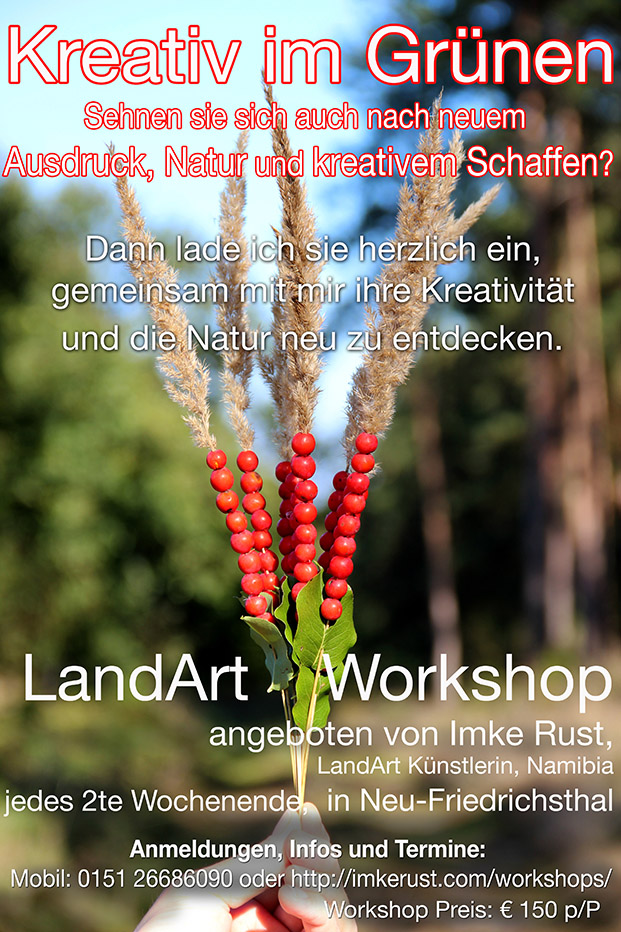
Kreativ im Grünen – Land Art Workshop

(Apologies to all my English-only readers. I am offering a land art workshop in Germany and so this post is in German. If you have any questions regarding this workshop, please use the comments option below and I will gladly answer you in English.)

webLAndArtWorkshop_ImkeRustPoster

Sehnen sie sich auch nach neuem Ausdruck, Natur und kreativem Schaffen?

Der Frühling ist die perfekte Zeit auch unsere Seele aufblühen zu lassen und neue Impulse in unser Leben zu bringen.

Lust auf etwas Neues und eine Auszeit vom Alltag? Dann lade ich sie herzlich ein, gemeinsam mit mir ihre Kreativität und die Natur neu zu entdecken.

Sie brauchen keine Vorkenntnisse, nur Offenheit, Freude an der Natur und Lust sich auszuprobieren.

webIRust_DSC02090(c)

Ziel des Workshops ist

  • zu inspirieren
  • die Freude am kreativen Schaffen und Ausdruck in und mit der Natur wieder zu entdecken.
  • Grundkenntnisse über die Möglichkeiten und Vorgehensweisen bei Land Art zu erwerben.
  • den bewussten Umgang mit der Natur, Materialien und Prozessen zu vermitteln.
  • Spaß am gemeinsamen Gedankenaustausch und kreativen Schaffen haben.

Wann:                       Jedes 2te Wochenende oder auf Anfrage (der nächste Termin: 9./10. Mai) 

Samstag 12h00 – 18h00 und Sonntag 11h00 – 18h00

Treffpunkt:               Atelier Imke Rust, Birkenstr. 11, OT Neu-Friedrichsthal, 16515 Oranienburg

Teilnehmer:              3 bis 6 pro Workshop (nur mit vorheriger Anmeldung)

>>> Bitte mitbringen:

  • Offenheit, Neugierde und Phantasie
  • Skizzen- oder Schreibblock oder Papier, Bleistift, Radiergummi
  • Wenn vorhanden: Fotoapparat, Taschenmesser, Korb oder Tasche zum Sammeln von Naturmaterialien
  • Wetter und naturtaugliche, bequeme Kleidung und Schuhe
  • Mittagessen – zum Teilen und gemeinsamen Essen
  • Etwas zu trinken für unterwegs.

Tee und Kekse für zwischendurch stehen bereit.

Wir werden Zeit draußen im Wald und auch im Atelier verbringen. Alles ist in kurzer Laufentfernung.


Nächste Termine:

9. -10. Mai 2015 (Samstag 12h00 – 18h00 und Sonntag 11h00 – 18h00)

23. – 24. Mai 2015 (Samstag 12h00 – 18h00 und Sonntag 11h00 – 18h00)

6. – 7. Juni 2015 (Samstag 12h00 – 18h00 und Sonntag 11h00 – 18h00)

Auf Anfrage gestalte ich auch gerne Workshops zu anderen Zeiten (min. 4 Teilnehmer).

Über mich, Imke Rust:

Ich bin eine namibisch-deutsche Land Art und multimediale Künstlerin, aufgewachsen in der Wüste Namibias. Seit 5 Jahren pendele ich zwischen meiner Heimat und Deutschland, zwischen Wüste und Wald. An der Universität von Südafrika absolvierte ich mein BA Degree in Visual Art und bin zweimalige Gewinnerin des wichtigsten Kunstpreis Namibias, der Standard Bank Namibia Biennale. In zahlreichen Solo und Gruppenausstellungen wurden Arbeiten von mir weltweit ausgestellt. Über ein Stipendium des Deutschen Akademischen Austauschdienstes (DAAD) kam ich 2006 das erste Mal nach Berlin.

Als Kuratorin der National Art Gallery of Namibia konnte ich auch fundierte Kenntnisse der Business-und Managementseite der Kunstwelt erwerben. Des Weiteren habe ich ein umfangreiches Kulturaustauschprojekt zwischen Namibia und Berlin mit einem deutschen Partner initiiert und über mehrere Jahre geleitet.

In meiner eigenen Kunst zieht es mich immer wieder raus in die Natur. Meine Freude am kreativen Schaffen teile ich gerne, unter anderem mit einem Land Art Projekt mit 8 afrikanischen Künstlern im größten National Park Namibias (Etosha), einigen Kunst Workshops in Namibia und Berlin, Installationen im öffentlichen Raum und über meinen Blog.

Ich freue mich darauf meine vielseitigen Erfahrungen, Tipps und Wissen mit euch zu teilen und euch bei der Entstehung eurer eigenen Land Art Arbeit zu begleiten.

Kennen sie jemanden der sich für diese Workshops interessieren könnte? Dann wäre ich ihnen sehr dankbar, wenn sie diese Information mit ihnen teilen!

Hier noch ein paar Bilder von vorherigen Workshops und eigenen LandArt Arbeiten:

New Forest Explorations

Untitled nature art by © Imke Rust

Untitled nature art by © Imke Rust

On the weekend we explored a new piece of forest close to our home. I enjoy that there is still so many interesting places we do not know all around our new home and especially so much nature. The days are slowly getting longer and occasionally the sun shows her presence. I am deeply grateful for that.

Have you ever considered how conditioned we are by the environment we grow up in, and that we are familiar with? Have you felt overwhelmed by new landscapes in a positive or negative way?

I realised that I am still feeling unfamiliar with the environment and that whenever I am outside I enjoy getting to know and experience all these unfamiliar impressions, like a tourist would do. But just like a tourist, I am still very aware of not belonging. It takes time, but slowly I am feeling a bit more familiar with the forest, the weather, the space and the animals around.

With all this nature around us, I found it strange that so far I had not felt called to make any art outside. Once I realised this, I also understood that it does take time to adjust to a new environment, especially if it is so much the opposite of what you know.

I can now already identify a few local birds and trees by name. I am getting a bit more used and comfortable with the winter weather and the wetness of this area. I have watched deer grazing, a fox walking past, studied a red kite circling above our heads and now I have also seen my first wild boars in the forest! They saw us first, so to be totally honest, I just saw three large dark backs running away from us in a split second.

All this makes me feel blessed and honoured to get to know this world.

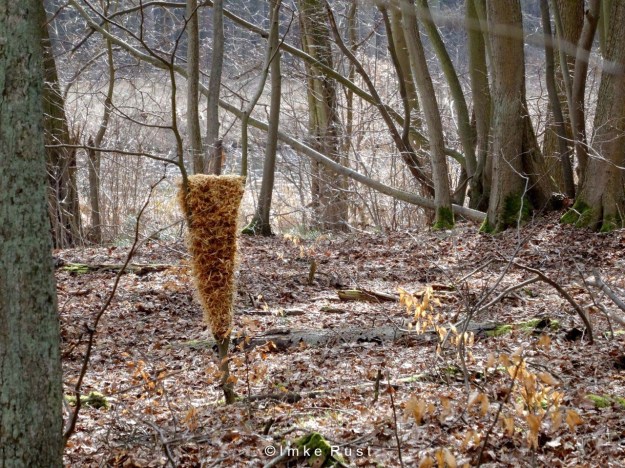
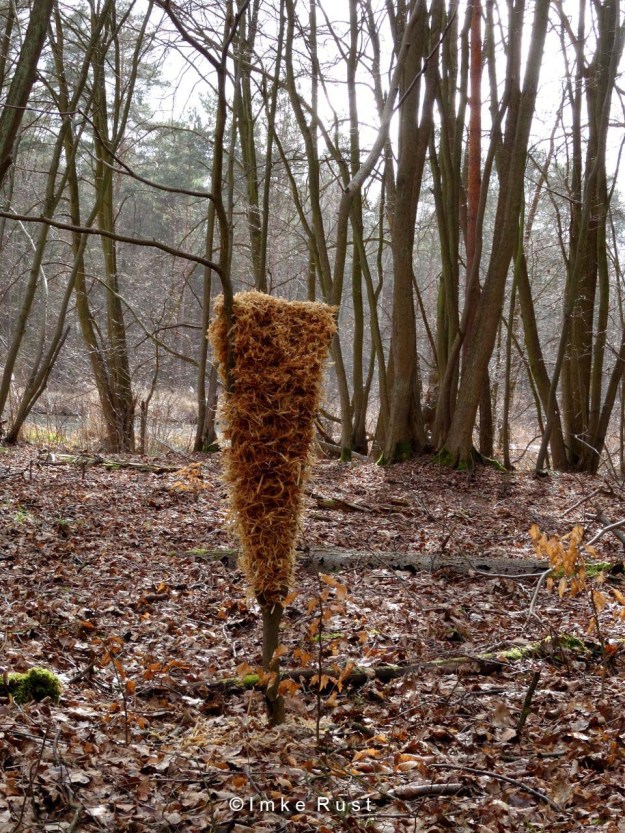
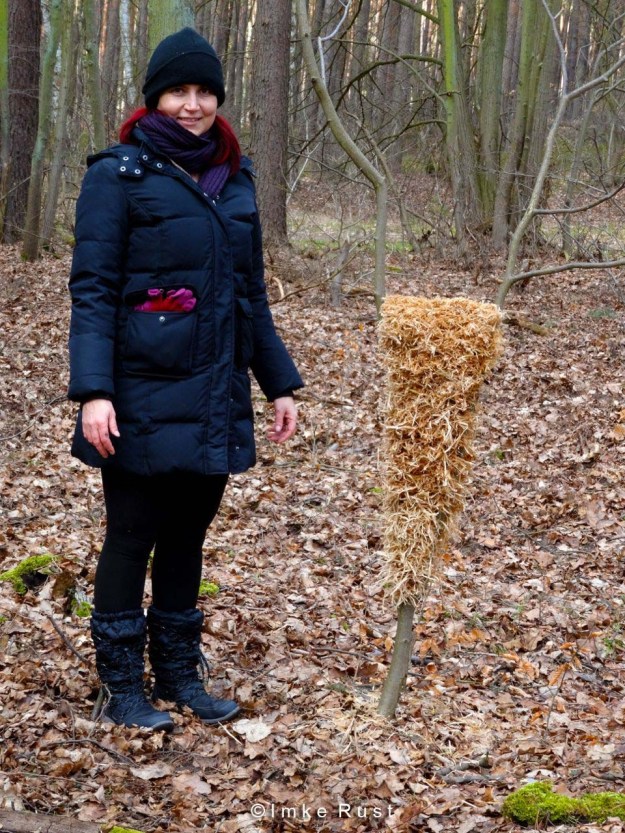
This weekend, on our walk through a forest, I suddenly regained the spontaneous inspiration to experiencing my surroundings creatively. While my husband continued his walk I stayed behind and just started. I found some wood shavings from a freshly cut tree and nearby a small V-shaped tree who called me….

It felt really good to be creating out in nature again and becoming aware of the challenges of a winter forest landscape. So different to a sunny desert plain…

Anyway here are a few pictures of my latest land art piece and I hope it will be followed by many more soon!

(Please click on the images for a larger view. Then use the arrows on the sides to get to the next image.)

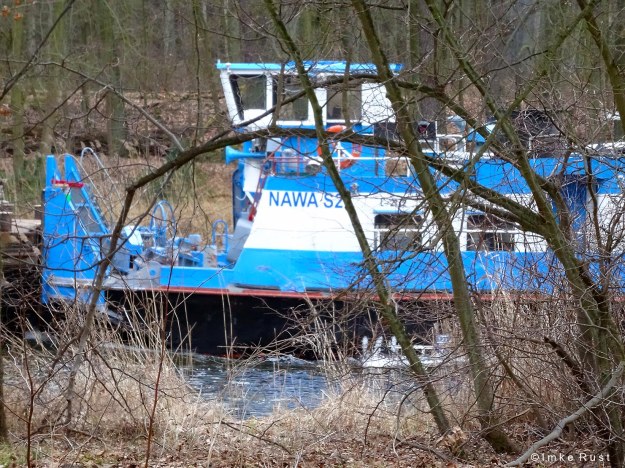
PS. Just a few meters away from this work is the Oder-Havel canal, and at some stage I turned around to this:

Nawa = Good!

Nawa = Good!

NAWA!

That moment when a ship passes you on an outing to the forest and reminds you all is well, and does so in a language you only associate with home i.e. Namibia… For the non-Namibians: Nawa means ‘good’ in Oshivambo and is used pretty wildly, even by non-Oshivambo speaking people.

Why I Believe we can Make it Rain

Rainmaking Experiment #4 by Imke Rust


„Yes, I believe we can make rain and we should!

Is it easy? No, but it is definitely more constructive and fun, than being prophets of misfortune and disaster and clinging to our fears.”

That is what I wrote in my last blog.

I might have left you wondering if I am crazy. Or if there could possibly be some truth to it. Or both. I hope that at least you did consider the option that it is possible and I hope that there was a tiny little voice inside of you that wished it was true.

That little voice is in me, and even though it is little, it is very strong.

It is the voice of my inner child, my idealist, my investigator and my rebel. My mind, which is intensely tuned into the creative-solution-finder mode, loves taking up a challenge, especially when it comes to improving our experience here on earth. So together we all have a strong interest in finding out if rainmaking is indeed possible and if so, how and what we can do.

Those of you who have been following my blog for a while, or have explored my webpage, know that I have experimented with this for the past 5 years. I have read all information I could get on the subject and am always on the lookout for new understandings. I have been putting together my own ideas and insights and started a few different experiments and have planned a few more. As usual, I love to throw all my information together, stir it and see what speaks to me, what makes the most sense and what is practical. Then I weave together those aspects with my personal ideas and creativity in an intuitive process and see what happens.

Possibly the one thing most of us still easily associate with rainmaking is a rain dance. I think most people have heard of it, but very few have any idea how it works. Me included. The idea of the rain dance was the starting point for me. I assume that the fact that there is such a thing practiced in many cultures and over many generations, told me, that there must be some truth to it.

Only bummer is, that my dancing skills are pretty awkward and I do not know the steps. Dancing sounds like a suitable thing to do – just not for me.

So I tried to understand what of the dance makes it rain? Simply put, I think it is a combination of a few things:

  • People coming together with the same intention,
  • People expressing joy and gratitude, but also respect and reverence to the weather,
  • people changing the energy and vibration through their creative action or ritual
  • And since like attracts like, that vibration attracts and favours the vibration of rain.


Most of the time I am on my own and not with a bunch of people who would be willing to partake in my experiments, but the rest of those findings I can somehow integrate into my experiments. And add some more of my personal creative ingredients…


I could write forever about this, but let me rather just share my Rainmaking Experiment #4 with you:

Rainmaking Experiment #4

What:

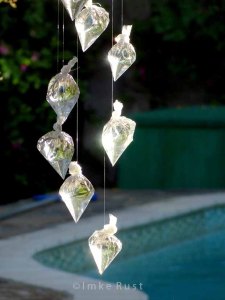
See-through plastic bags filled with water and closed with a knot. These bags are then tied with fishing line to a branch, like a mobile. I enjoyed looking at it as often as I could. Every time I saw the drops I paused for a moment in awareness, gratitude and joy. I consciouly remembered the smell, sound and feeling of rain when I saw these oversized ‘raindrops’.

Ritual:

After having these mobile water drops hanging in my garden for a while I started to pinch a small hole into the bottom of one of the drops every day. Then I watched with gratitude how the water slowly poured out in small drops over some time. This ritual added another layer to the rainmaker, by giving it movement, real dripping water and continuity (for the duration of the dripping, but also for the daily morning ritual.)

Why:

To create rain, I guess it is helpful to remind nature of its watery and wet side. The plastic bags formed visual drops and on top of that were filled with water. Combined they looked like rain.

Once the installation was hanging for a while, I increased the sense of rain and water by releasing the water from the plastic bags in a ritual activity.

Outcome:

It started raining even before all drops were emptied and there were still more rains coming afterwards.

Please click on the images to see them enlarged and individually.

To find out more about my rainmaking experiemnts and ideas, please read my previous blogs on this subject HERE

Feeling the Drought in Me

'I am Desert' by Imke Rust

‘I am Desert I’ by Imke Rust (Photography, Digital print on Alu-Dibond)

There is a blurring, hot tension in the air. Even though I am not there, I am so familiar with this situation that my body physically reacts to it every time I think about it or remember the many years of experiencing this same intense and ominous collective fear of an upcoming drought.

I feel how this fear increases with every day in which the sun burns from the bluest skies with no cloud in sight. I feel the heat and the dust and the lack.

The lack of everything…

lack of aliveness and lack of hope.

I can taste the dryness.

But mostly I feel the silent terror and doom hanging in the air like an invisible monster.

I have experienced the impact of a serious drought. And I have experienced the fear oozing out of every wretched discussion, which repeatedly circled around the drought and the rain like a starving dog tied to a tree sniffing some fresh meat in the distance.

The elderly compared and remembered the many droughts they have experienced and seemed to revel in reciting their horrors. The younger, who could not rely on memories that much, were more likely to speculate according to the weather forecasts, the dreaded El-Niño phenomena or any other scientific statistics or findings. I remember these discussions as mostly negative, fearful and resigned, sometimes angry and usually interrupted only with long heavy pauses, knowing glances and deep sighs. For one or other reason, everybody seemed to know that we would be doomed with another great drought, as if by stating the worst that can happen, we are bracing ourselves for it. The few hopeful voices in between quickly got lost or talked into submission.

This fear and the helplessness have crept into my bones. As a child I listened to all these discussions in the hope that somewhere some one would have a solution or know for sure what is going to happen. Will it rain?

Hoping to find somebody who could say: it is going to be okay, even if it doesn’t. Even as a child I knew, that no matter what people said, the rains are not always forthcoming, that is just part of living in a desert country. So I hoped to find some way of creating hope and faith that the natural order of things are okay…

The older I became, the more resigned I became. I had accumulated more experience with dry years, with droughts and the impact it had on our life.

Yes, I fear the droughts. Deeply. But I came to fear one thing even more: the continuous doom saying and negative speculating that happens throughout the year, but increasingly in the rainy-season, when this seems to be the only topic on everybody’s minds. And the feeling of helplessness.

Sure, when the rains come and when they are good, we all are grateful for a moment, only to easily and quickly forget our moaning and return to life as we know and want it.

When the rains do not come, or let us wait too long, we are spiralling down into an ever darker abyss of fear, lack and death. I came to think of this as natural, but when I became more aware of physically experiencing the discomfort of cringing cells in my body whenever I think about this, I started to question what is happening. Even more so, when I realised that even far away from home, in Germany, I am not immune to this.

What is natural is that we are living in a very dry country – in Namibia, named after one of the oldest deserts, with unpredictable and variable rainfall. What (according to me) is not natural is how we deal with it.

I understand the fear, because I feel it too. But I refuse to believe that this deep fear and immense sense of being helpless at the hands of the weather is necessary, natural or useful. I also feel that the relentless doom-mongering and negativity is the worst way of expressing this fear or avoiding the situation.

This constant distress is killing our souls and we have let the drought creep into our hearts and veins.

I started thinking about the ancient San people in Namibia and then also about so many different ancient cultures, maybe the most well-known being the American Indians. All people throughout history were exposed to the unpredictability of the weather and to extreme conditions, droughts, floods, raging storms and endless freezing winters. Maybe it is idealistic of me to assume that the people long ago had a better relationship to the woes of the climate and nature, but from the stories that we have from that time, I am sure they knew something, which we have lost.

I guess the core difference is that they lived with deep respect and reverence towards nature and understood the importance of a healthy give-and-take relationship with everything around them. They understood themselves as a small part or children of this much larger Mother Earth.

We on the other hand have come to view ourselves as masters of the earth. We believe it is our birth-right to exploit any natural resources, to take without giving and separate and put us above the rest of nature.

We have made man the centre of the universe and profit our highest and only purpose.

Every time a drought looms, we are uncomfortably reminded, that we are not the masters of this universe. Our presumed intelligence, scientific and technological advancements and our arrogance all are futile, when the environment stops supporting us. When earth stops to produce new resources. When earth dries up and shrivels under our endless and greedy exploitation.

We are at the mercy of a benevolent environment and we are part of everything that happens. The old people understood that, we don’t.

With every drought we get angrier and more fearful. People like farmers who live closer to nature feel it first and the most intense, while others can ignore it for longer, as they have already distanced themselves so much from nature. Their money can still buy food, when the animals and plants on the farm already starve, but eventually their money also will have nothing left to buy.

What if we all would be willing and open to rethink the possibility living more in tune with nature again? Before nature forces us to. What if we would stop investing our energy in complaining and doomsaying and instead find better ways of prepare and deal with reality?

'I am desert II' by Imke Rust

‘I am desert’ by Imke Rust
Photography, Digital print on Alu-Dibond

I refuse to believe that we are separate or above nature. And I refuse to believe that we are powerless. Not only should we honour and respect mother earth, but we should accept the responsibility that comes with it. If we understand that we are but a small part of the whole, yet we are an important and powerful part.

If we would see us as the hand of a person, we would understand that the hand is subjected to what the body does, but at the same time, it also has an important purpose and function. It is powerful in its own right, but not of its own. It needs the body. And the body needs the hand. The hand cannot complain that it is starving, if it refuses to act in its power and pick the fruit and bring it to the mouth.

My research and exploration into old rainmaking traditions have shown me, that we have the answers and the power of our destiny within us. Yes, there are forces larger than us, but we are part of those, and thus we also can have an impact.

Rainmaking has become synonymous to me with actively co-creating our reality, to become conscious of our part in this grand oneness and act accordingly.

We can choose how we want to act out this role. We might not be able to change Namibia into a rainforest, but we can learn to accept that we are living in an arid country, we can take responsibility for living within the means of what is available and the courage to act as blessings to our surroundings.

We can honour and respect what we have, and express our joy and gratitude in a thousand ways.

We can use our power to change our ways and find ways to better serve our earth-body.

Yes, I believe we can make rain and we should!

Is it easy? No, but it is definitely more constructive and fun, than being prophets of misfortune and disaster and clinging to our fears.

Do you fear being at the receiving end of the weather and climate around you? In what ways do you deal with that fear? And what is your solution? Do you save water? Have you ever performed a raindance? Or have you consciously prayed for rain? I would love to hear your thoughts and ideas!

If you want to read more about my thoughts and actions on rainmaking, please click HERE to see a list of all blog posts on this subject.

( I started writing this as a short introduction to one of my rainmaking experiments which I wanted to share with you, but then it turned out to be a loooooong introduction and I decided to rather let you digest this first, and share the experiment with you in the next post.)