Category Archives: Land Art

Relationships, Art & Healing

Relationships

As long as I can remember I have been intrigued by the underlying patterns and relationships between people, things and events.
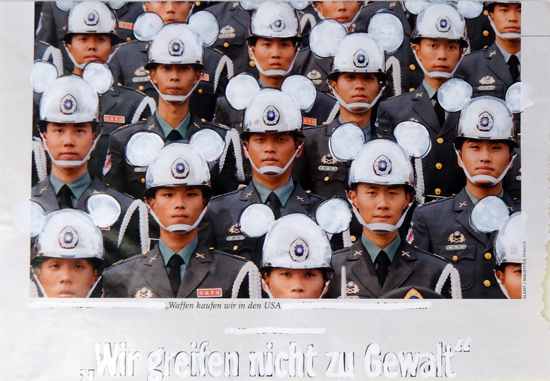
Waffen kaufen wir in den USA © IRust

Waffen kaufen wir in den USA © IRust (Tippex on magazine page) (Translation of the title: We buy our weapons in the USA)

I have always been trying to get a better understanding of what life is all about, as the normal explanations, which our society has to offer, seldom seem convincing or desirable to me. Since childhood I have been convinced that there must be better ways for us to do things (all kinds of things). Surely there must be a better life out there for all of us?

If something does not feel right and makes me really happy, I just do not want to accept that this is how it is supposed to be, just because people say so. I do not care if their arguments are based on religion, social rules, scientific research or other dogmas. I have been called stubborn and insubordinate, but at least nobody can accuse me of being a sheep, and it felt good to go ahead and do something which I was told I could not do or find my own better or more efficient way to do things.

I believe that there is more to life and living than what we commonly accept to be true. The world is not flat, no matter how many scientists have said it is. It is not OK to kill somebody, no matter how many religions supposedly tell us that we have to fight wars in the name of some god. It is not acceptable to place the profits of a few over the health and well-being of a whole community. I refuse to accept that millions of people live in great poverty and hunger.

Art

I guess that is why I have become an artist. Artist in the widest possible sense of our understanding of art.

Art as a creative tool – creating a new or better reality. A tool that can access the world of the soul. A tool that is rooted in imagination and vision. A tool that is based on colours, forms and materials just as much as it is on ideas, hope and dreams.
Art, which shows us something, which we have not seen before.
Art that opens us up to possibilities and new thoughts.
Art, which reminds us of who we are.

Preperation sketch for a painting

Preparation sketch for a painting

Healing

And I guess, that is the reason that I am interested in alternative healing and living methods. Once again, I talk of healing in a much wider sense, in the sense of wholeness. This wholeness is not limited to being whole (or healthy) in our physical body, but also in our spirits, our ways, our actions, basically in our whole being. Being whole also means to be part of the whole – of everything there is. Understanding that we are connected to every other being on this planet, including ‘things’ we do not consider to be alive, like water, soil, rocks or energies.

The bottom line…

Unfortunately, I do not know the answers or have a no-fail solution, or am able to live my life in the perfect harmony which I wish for, but what I can say, is that I will continue to ask the questions and keep on searching and keep on using my art as a vehicle to express my questions and thoughts, explore the possibilities and try to find a better way.

I have shared these thoughts with you, as I believe that they are fundamental for understanding my approach to my art and my life. I think it might be a good introduction to the next few articles, which I will be posting about my current work. And another selfish reason I do this for:  sometimes it is good for me to take stock and get back to the basics, in times when I am facing obstacles and frustrations and need to remind myself why I am doing what I am doing, so that I find the courage to continue and do not give up.
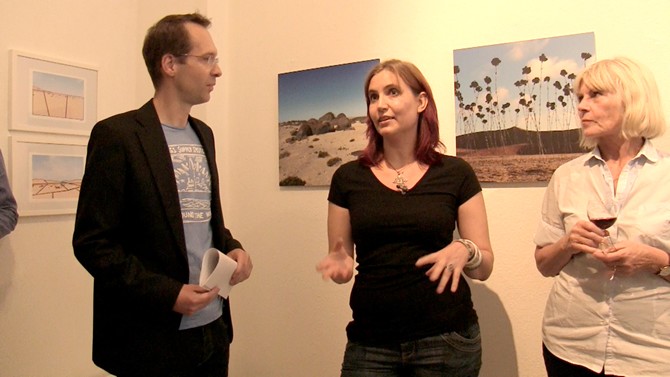
The exhibition is officially declared open…

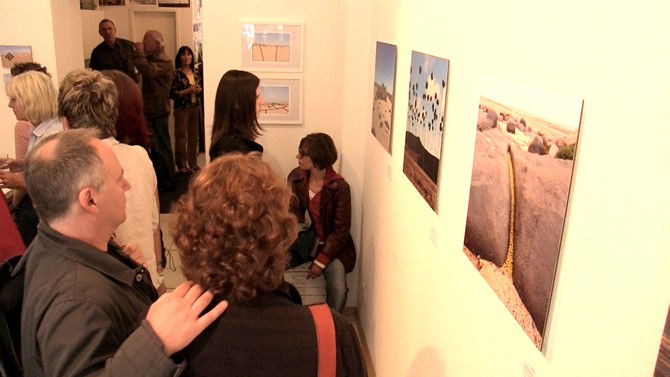
The opening of my solo exhibition “Goldgräberstimmung” (Goldrush Mood) on Saturday has drawn people from all over Berlin to Rigaer Street 62 in Friedrichshain, Berlin – some even came all the way from Bremen and Leipzig. There were enough art-loving people and special friends to fill and keep the small space continuously bubbling for more than three hours.

What would art be, if nobody sees or experiences it?

So thank you to everybody who made the time and effort to be there and share the fruits of my work, thoughts and passion with me. For those who could not attend the opening, you still have a chance to see the works throughout the next four weeks (please see my previous blog-post for more details on the gallery’s opening times etc.)

Another big Thank You goes to Jens Garling who opened the exhibition for me, with a lively and wonderful speech, to the Neumann Galerie for hosting the exhibition and to Steffen Holzkamp for all the support before and during the opening.

I would love to post pictures of the artworks on my blog, but am not sure if it will spoil the interest for the people who would like to see the artworks in real? Please let me know what is your opinion: to show or not to show?

Till I have come to a decision, here are a few pictures of the opening:

With Jens Garling and Ms Gisela Neumann

Opening speech by Jens Garling (with Ms Gisela Neumann)

Interested guests viewing the video

Interested guests viewing the video

Goldgraeberstimmung Ausstellung

Goldgraeberstimmung Ausstellung


Goldgräberstimmung (Gold-rush Mood) Upcoming Exhibition

Whoohoo – It’s exhibition time… please save the date! Book a ticket and come to Berlin!

My next solo exhibition “Goldgräberstimmung” will be on show in Germany’s capital, Berlin, on Saturday, the 16th of June (17h30) at the Grafik Studio Galerie Neumann. Jens Garling will give a brief introduction to the works.

On show will be a small selection of land art works and public art actions (in form of photographic and video documentation) which I have created in April12 in the Namib Desert and some mixed media works.

Goldgräberstimmung/Gold-rush Mood by Imke Rust

Goldgräberstimmung/Gold-rush Mood – an exhibition by Imke Rust

About the works: “Imke Rust uses her art to draw attention to the human exploitation and destruction of the Namib desert. The works are loosely based on ancient shamanic traditions and symbols, while the artist worked in and with nature, in order to establish a more direct connection between humans, nature, art and the spiritual world. The Namibian-German artist will show video, photography and mixed media works.”

The exhibition can be viewed until the 16th of July.

Opening times of the gallery:
Mon – Tues: 10h00 – 17h00, Wed: 9h00 – 14h00,
Thur 12h00 – 18h00 and Fri 9h00 – 13h00
If you would like to view the exhibition after hours or on weekends you can make an appointment with me via email:  imkerust(at)iway.na

Please feel free to invite your friends along and also to purchase some of my works.

I hope to see you there!

Artworks shown on the invitation:

SubRosa (Under the Rose)
Temporary installation in the Namib Desert Dune belt south of Swakopmund.
22° 43’ 01” S – 14° 33’ 47” E
Original dimensions: 90 x 270 x270cm
99 roses made of black rubbish bags, barbed wire, wire
April 2012 ©Imke Rust

and

Toxic Rocks
Temporary installation at the “Black Rocks” close to Wlotzkasbaken, Namib Desert.
22° 25’ 55” S – 14° 27’ 42” E
Approximate original dimensions: 200 x 2500 x 2000 cm
Rocks wrapped in neo colored tulle
April 2012 ©Imke Rust

If you like my art, please  join my Facebook Artist Page .

Encounters in the Namib

A bird puzzled by my artwork in the desert © Imke Rust

A bird puzzled by my artwork in the desert © Imke Rust (detailed view)

I have spent eight days in the beginning of April in the desert around the coastal town of Swakopmund to make artworks in nature. It is my way to raise awareness about the threats which our environment is facing. And it is my way of taking action. I believe that art is not only an aesthetic experience, but also a powerful and spiritual one. Just like the shamans and healers of the olden days have used drawings, symbols, rituals and objects to heal and change the vibrations of the current reality, I hope that my art can have a positive and healing influence.

The Namib Desert at the Atlantic coast in Namibia is currently under much threat, with uranium mines springing up and growing like fungi, huge chemical plants proposed to be built (who plan to get rid of their toxic waste in the Atlantic ocean) and even Phosphor mining plans on our shores. Not only these big obvious projects are threatening the desert and ocean, but also the thousands of people who mindlessly use the environment as their playground without consideration or awareness of the damage they are doing.

I am happy that more and more people are standing up and making their voices heard for saving our environment and there even being signs and actions from our government which gives us hope that they are not going to sell out our desert. I thought a lot about what I can do for my part, and decided that I stick to what I do best: art. Instead of painting posters against the ‘enemy’ I decided to do things pro nature, make artworks which symbolically protect the land from harm, bless it and celebrate its beauty, while at the same time raising awareness about the threats.

I am busy preparing the documentation of the works for my upcoming exhibition in June in Berlin and want to keep the artworks a surprise till then. Instead I will share with you pictures of some of the meetings we had during the eight days, in which we worked in the desert. Just to show you how alive the desert really is with creatures we often do not even notice. All of these and many, many more depend on our choices for their survival. And our own survival depends on a healthy and alive environment.

Horned Viper taking refuge in a shaded burrow

Horned Viper taking refuge in a shaded burrow

Although I have much time of my life in the desert, it is the first time that I personally spotted this highly poisonous small snake. A good reminder for me to tread carefully for my own protection and on the other hand I felt sadness, as she was living in an area where sand is mined and I guess it is only a matter of time, before she ends up being killed by the huge machines.

A  well camouflaged desert gecko

A well camouflaged desert gecko

Another gecko, not as fussed with camouflaging

Another gecko, not as fussed with camouflaging

A lizard who has lost its tail

A lizard who has lost its tail

A very friendly and inquisitive pregnant chameleon

A very friendly and inquisitive pregnant chameleon

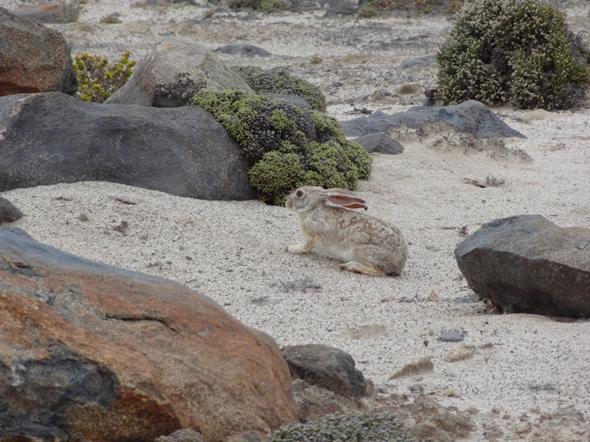
A desert rabbit, sitting very still, in the hope that we do not see it...

A desert rabbit, sitting very still, in the hope that we do not see it…

A black scorpion

A black scorpion – very poisonous (you can tell from the large stingers and small fangs)

These are only some of the animals which we encountered while working in the desert, as I did not always have my camera ready….  I was so amazed to notice just how alive the desert really is.

Oh, and then while marveling at the horned viper, we also encountered some very noisy two-wheeled creatures:

Motorcycles and plastic bags in the desert

Motorcycles and plastic bags in the desert

I wonder how many of our small new friends they noticed? And how many of them survived the encounter?

If this matter is also close to your heart and you would like to show your support for the environment of the Namib Desert, especially around Swakopmund, please join the Facebook group Industrial Swakopmund – What Future do we Want?” and stay updated about the latest news and actions.

The art project was funded, in part, through a Grant by the National Arts Council of Namibia (NACN),  the opinions, findings and conclusions or recommendations expressed herein are those of the Author(s) and do not necessarily reflect those of the NACN.LOGO NACN

Hand-coloured Photographs Making a Powerful Statement

Chemical Reaction (Namib Desert) © Imke Rust

Chemical Reaction (Namib Desert) © Imke Rust

Recently I have invited you all to come to an exhibition of a selection of photographs which were submitted to the “Our Coast Your Photo” Competition, which was on show in Windhoek and Swakopmund.

Initially I was informed that I was one of the finalists, but then at the opening it turned out that the judges did not think that hand-coloured photographs are photographs but are art, and therefore my works were not considered for the actual prizes.  A detailed discussion of this decision would be interesting, considering that hand-colouring photographs is a technique used in photography for almost as long as we have photography itself, but maybe I leave that for another time or for the comments.

For now, I am happy to say that the organizers did think that my work still deserved a “special mention for making a powerful statement. … Rust managed to convey a message of “pretty promises” made by industrialists that paint a pretty picture, while the result would actually be unnatural – and even detrimental to the environment.” (quoted from The Namibian, 2 April 2012, pg7). The special mention came with a small financial prize and a bottle of unpolluted Namibian sea water – which I thought was a very nice touch in line with the background of the exhibition. It might become a rarity soon, but I hope not!

Here are the works which I have submitted for those of you who were not able to see them in person.

Toxic Flow (Swakop River)  © Imke Rust, Digital Photograph

Toxic Flow (Swakop River)
© Imke Rust, Digital Photograph

Toxic Waste (Moon Valley)  © Imke Rust

Toxic Waste (Moon Valley) © Imke Rust

About the works:

“My entries are hand-coloured photographs of  Swakopmund’s surrounding environment.

The idea came while I was in Berlin and was hearing about the planed chemical works that might be built near Swakopmund.  I looked at my photographs of Swakopmund and its surrounding area which I took earlier in the year and wondered what it will look like should the chemical plant be build with all its toxic waste and side effects. I also thought of the “pretty promises” that are made of all the wonderful things (like job creation) such developments would bring Namibians. What at first glance might look pretty and interesting might turn out to be really dangerous, and we are not really aware of how far-reaching the negative effects might be. The colourful interventions on the photographs, give a striking and ‘pretty’ effect, but also allude to the chemical and toxic interference with nature.

We are so used to see really good photographs of the Namibian environment and we often taken our environment for granted. That is why I decided to make some physical and ‘chemical’ interventions in bright and ‘unnatural’ acrylic (plastic) colours to the photographs. I hope this artificial, tampered view, makes people sit up and notice and think about what they are seeing and want to see.”

The exhibition is still up in Swakopmund at “The Art Gallery” in the Brauhaus Arcade till the end of April. According to that gallery it is one of their most visited exhibitions to date. So, if you are in Swakopmund, do take some time to go and see all the finalists work (and mine 😉 ) if you enjoy photography, art and our beautiful coast!

Oh, and I would love to hear your thoughts on the subject:  is photography art and is art photography? Should a hand-coloured photograph be judged differently than a photoshopped one, or an 100% untouched one? Let me know what you think…

Tokoloshe Trap (or How to Catch Creatures of the Night)

(Update 21 March 2013: To see pictures and a description of the final artwork, please click here.)

I am hard at work preparing for a land art project which I am planning to do at the coast soon, and have been spending much time finding and cutting white thorns. These long, straight, white thorns, growing in pairs at an about 90degree angle to each other, are something I typically relate with Namibia. Different kinds of trees and bushes grow them and they look stunning, but are also really painful if you step into one.

Weissdoerner

I plan to use many (as in thousands) of these thorns, so I have been spending my past few days cutting these thorns off their branches. To get a break from this tedious task, I decided to arrange some of the cut thorns in my garden to see what it looks like. I decided on a simple circle shape. And this is what it looked like.

thorn circle

Cat & thorn circle

My cat is in the second picture, since she took great interest in my arranging the thorns and continuously interfered, thinking it is great to bite the thorns, rub her chin on them or walk straight through them. All of which was not very helpful and after I have pushed her away too often, she gave me the cold shoulder. (This picture also serves to give you an idea of the size of the thorns, and these one’s are medium-sized!)

Since it was late in the afternoon, I decided to leave the thorns in the garden and wait till the morning to get some of the morning sun for some extra pictures. When I came back to it early in the morning, I realized that some animal walked into the thorns. The circle was damaged and it was surrounded with tracks.

damaged thorn circle

Scratch marks next to thorn circle Spoor next to thorn circle

First I thought it might have been my cat, but the strangest thing is that judging by the size of the scratch marks and spoors, the animal must have been huge, something like a big dog. I know that a mongoose often comes to visit at night and stalk around my compost heap, but other than that, there is no large enough entry into my yard, for anything bigger than a cat. Unless it can fly…

Festus, who sometimes helps me in the garden and whom I called to ask if he could identify the spoor, was not sure what it could be either. But for some reason he thought it might be the perfect time to ask me what the word “Tokoloshe” means.

Wikipedia describes it as follows:

“In Zulu mythology, Tikoloshe, Tokoloshe or Hili (from the Xhosa word utyreeci ukujamaal) is a dwarf-like water sprite. It is considered a mischievous and evil spirit that can become invisible by swallowing a pebble. Tokoloshes are called upon by malevolent people to cause trouble for others. At its least harmful a tokoloshe can be used to scare children, but its power extends to causing illness and even death upon the victim. The way to get rid of him is to call in the n’anga (witch doctor), who has the power to banish him from the area.”

So, maybe it was a Tokoloshe?

Hmm, I am still puzzled by what it could have been, but at least I know one thing for sure: whatever it was, it stepped right into the thorns and will surely remember the pain and not come back soon.

And if I ever should need an additional income to my art, maybe I can patent this as a form of Tokoloshe Trap and catch some evil spirits roaming the land. 🙂

Detail Tokoloshe Trap

Detail Tokoloshe Trap

My work on show at the ‘Our Coast Your Photo’ Exhibition

(Read right to the bottom, as there is a chance for you to win N$ 1000.00, too!)

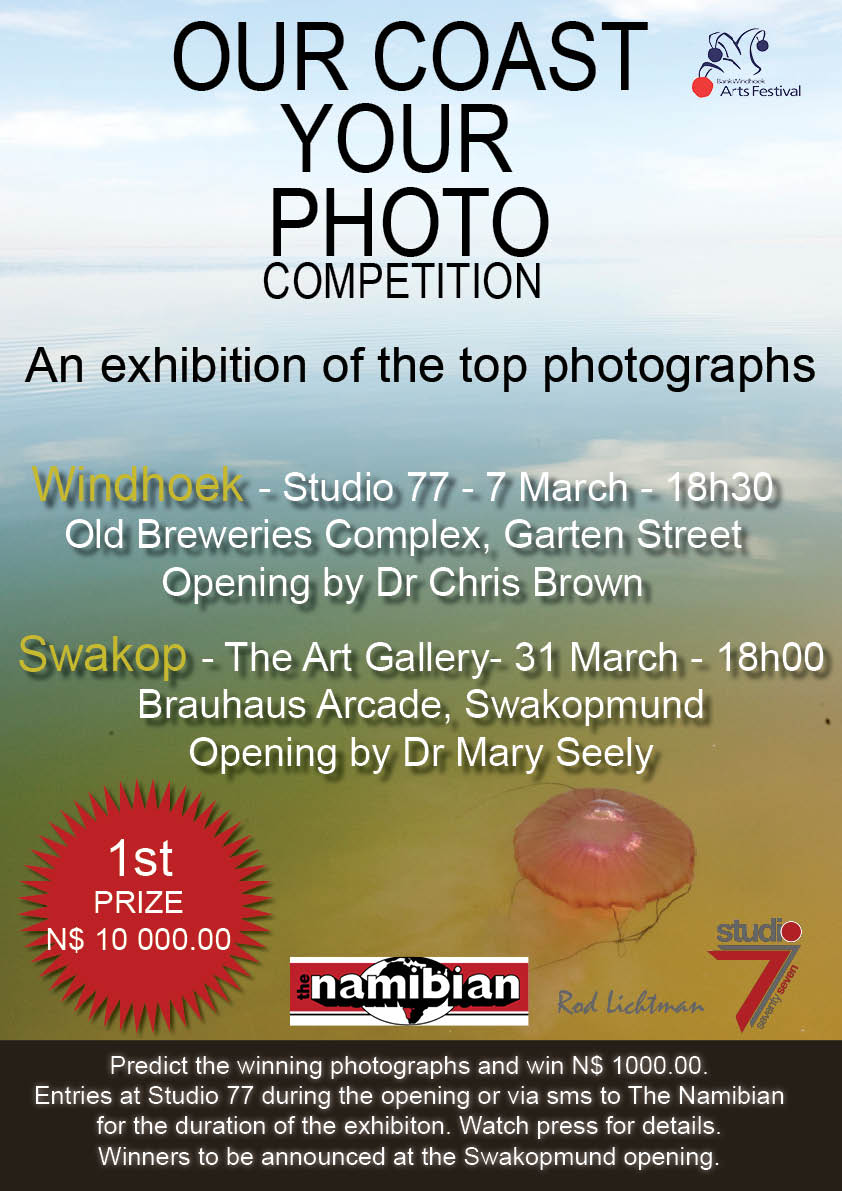
In January Tony Figueira of Studio77and the Namibian Newspaper launched a photographic competition “Our Coast Your Photo” in an attempt to highlight the concern about the coastal environment in light of the proposed industrial & mining plans….

OUR COAST YOUR PHOTO POSTER

From the close to 600 entries a selection of about 50 photographs, plus the top category entries, will be exhibited. The winning photograph will be announced at the opening of the Swakopmund exhibition on 31 March, and this person will walk away with the N$10 000 in cash.The judges of the competition are Amy Schoeman, Roy van der Merwe and Taimi Shejavali.

I participated in this competition, because I believe strongly that we all need to get involved to protect our environment and what better way for an artist to use their art? And this particular subject matter bothered me some time ago and I actually just had finished some work, which I thought would be perfect for this competition. And why this is even more exciting? I have been told that I am one of the finalists….*blush*

So all you lovely people, if you happen to be in Windhoek or Swakopmund at those dates, come to the opening and support this great cause! I would love to see you all there and I am sure there will be many exciting works on show. If you cannot make it for the openings, well, there is more time to view the shows afterwards too, so don’t miss it.

And there is another good reason to go and view the exhibition:

The Organizers have now compiled the top photographs for each category, and are inviting the public to predict the winner in each category via SMS! The person who predicts the correct photographs in all the categories, will stand a chance to win N$1000! For those of you who are not in town, these photographs will be available as from 8 March 2012 on the website of The Namibian Newspaper and the Facebook site for the competition.

Looking forward to seeing you either in Windhoek or Swakopmund. And keep watching this space – I will post some pics of my artworks after the opening.

Waiting in an ashtray…

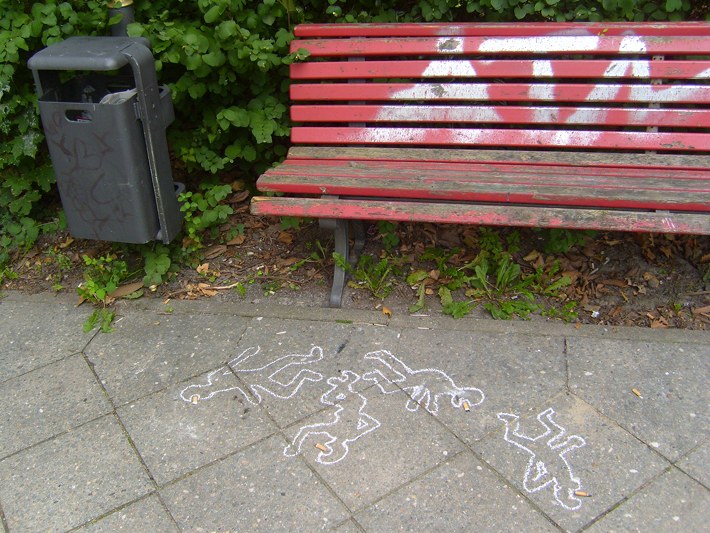
Everyday  waiting for the bus or the S-Bahn I witness one of the most intriguing phenomena: the careless-flipping-away-of-cigarette-buds.

In most smokers minds’ cigarette buds do not seem to be classified as litter. No, I do not hate smokers, I just do not understand this part of their actions (and yes, I do feel a bit offended by it). Has it ever occurred to you that cigarette buds are litter and belong into a bin or ashtray and not on the public floor?

It is not as if the person looks around for a rubbish bin, then cannot find one or thinks it’s too far to walk to, and then decides to rather drop it on the floor. It seems to be a totally unconscious act. Maybe somebody can explain this to me? It is a mystery to me. I assume, you do not just drop the buds on your floor at home – or do you?

I salute the few smokers who carry a portable ashtray and use it to store their ash and buds or those who are conscious enough to make use of public rubbish bins.

As I found this so intriguing, I thought I have a bit of my own fun:

Smoke Victims

Smoke Victims

busy drawing

Drawing

Smoke Victims

Smoke Victims (close up)

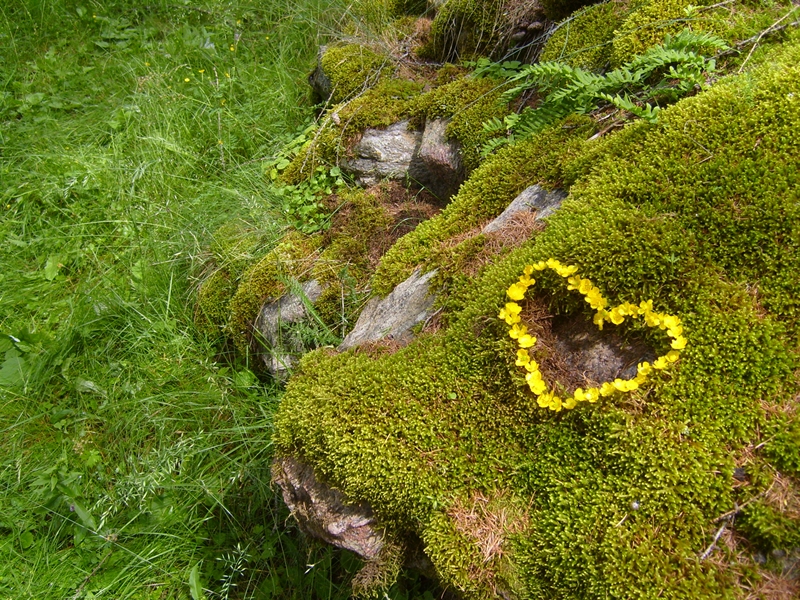
In search of elves and fairies and green, green grass


Yellow Heart

Yellow Heart - Yellow flowers and moss on a rock


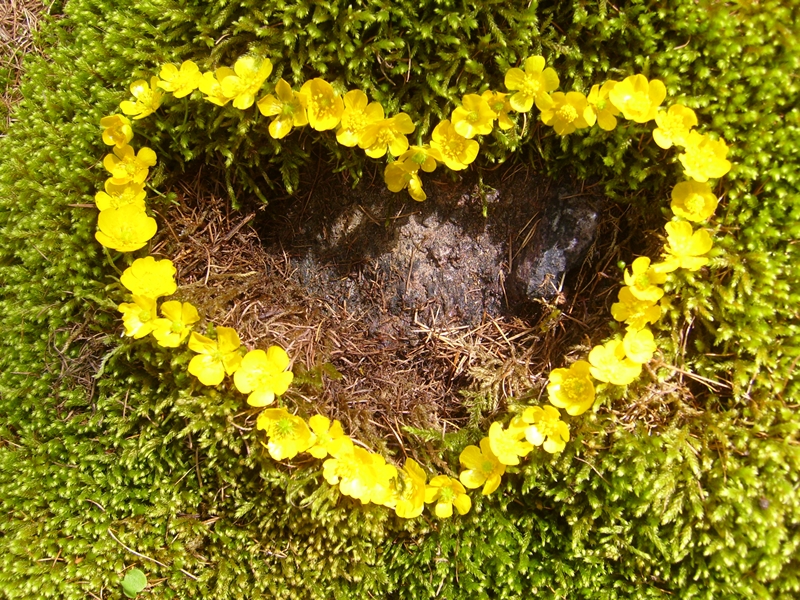
As a Namibian desert girl I recently had an interesting and exciting time in the very green and lush mountains of South Tyrol. All the dense vegetation was amazing, the little mountain creeks with their clear water fascinating and I especially fell in love with the soft moss growing everywhere. I was reminded of childhood stories of dwarfs, fairies and elves living in the forests and sleeping on beds of moss, carrying sweet forest berries as decoration and giggling under red and white mushrooms… as a child I did not know these things and wonderful places and my imagination ran wild. Now I walked through such magical forests in awe and wonder like a little child, eating some forest strawberries and making some art. I did not see any elves or red-capped dwarfs, but still I had lots of fun with the invisible spirits of nature and art.

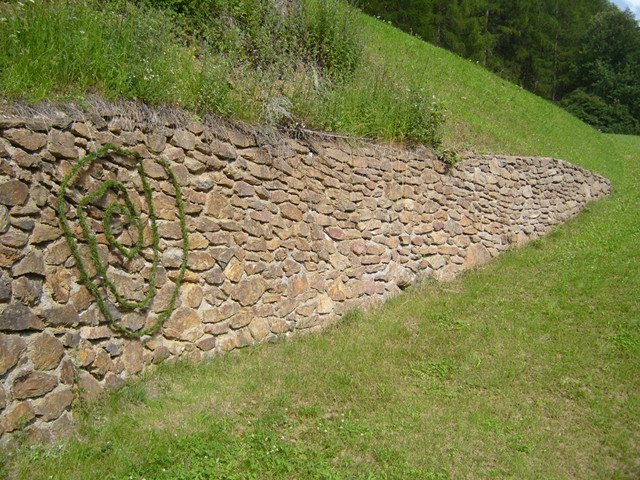
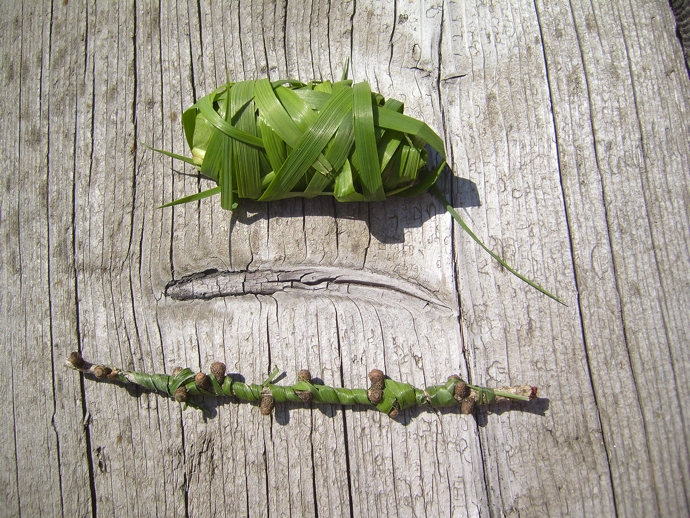
Ok, I do not want to bore you with long stories, but rather just share some pictures of my small interventions in nature. So, here they are:

Location: Oberperflhof, approximately 1,500m above sea level, close to Katharinaberg / Monte Santa Caterina –  in the Schnalsvalley (Val Senales), Italy.

Date: July 2011

Yellow Heart

Yellow Heart (close) - Yellow flowers and moss on a rock


Green Sprial

8m garland woven of small cedar branches


Sprial on stone wall (8m garland woven of small cedar branches)

Sprial on stone wall (8m garland woven of small cedar branches)


Wrapped

Rock, branch & grass


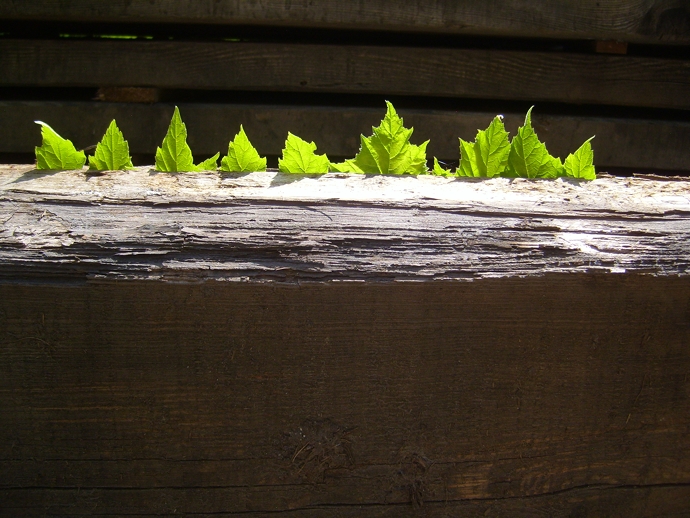
Row of leaves

Light, leave tips and wood

Berlin Stages

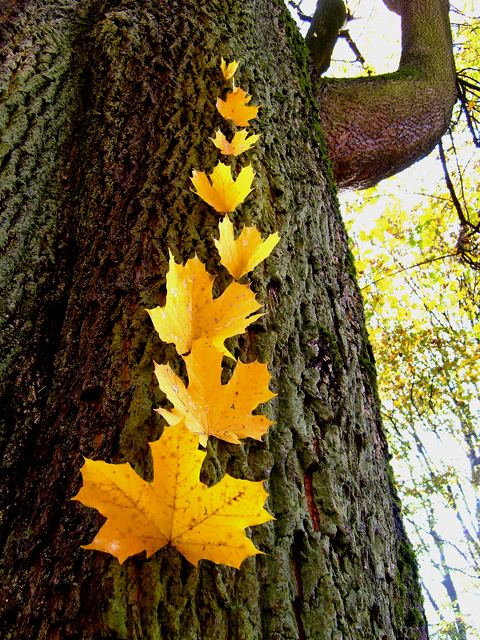
line of leaves IRust

Lline of Leaves by Imke Rust, Bochum

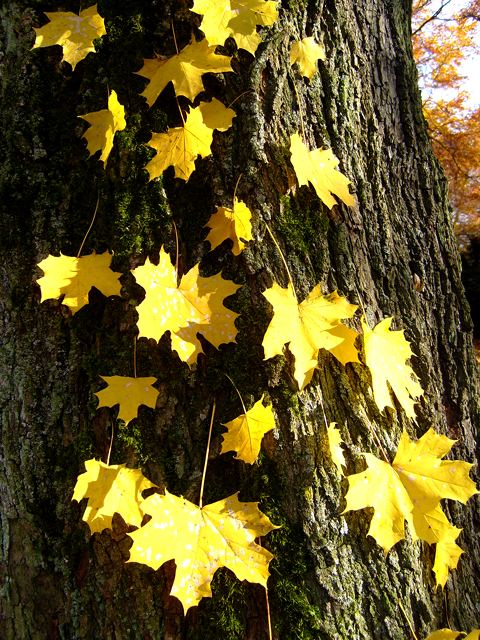
Golden Leaves by Imke Rust

Golden Leaves by Imke Rust, Bochum

This week a handful of guests from all over Europe are discovering Berlin as part of a film workshop entitled “Berlin Stages” funded by the EU and organized by Frameworks e.V.. The invited guests have a chance to experience an artistic Berlin with a HD film camera, as they will be meeting and filming Berlin artists and are getting some hands-on opportunity to create their own art together with these artists. I am one of the artists that they will be visiting (tomorrow) and we will be doing land art in the Lankwitz Community Park (my current studio till I can move into a ‘real’ studio with a roof in middle of July hopefully). I am looking forward to an exciting and fun day in the park tomorrow and keeping my fingers crossed for good and dry weather. If you are in the area, come by and share in the fun!

The results of their workshop will be shown on Thursday, the 7th of July at 20h00 at the Holiday Inn City East. Everybody is cordially invited. Hope to see you there!

More info about the project can be found below (unfortunately only in German) or on www.frameworks-berlin.de

Mit „Berlin Stages“ ist dem Berliner Verein FRAMEWORKS e. V. gelungen, aus einem der begehrten EU-Fördertöpfe Geld zu werben, um Gäste zu einem Film-Workshop nach Berlin einzuladen. „Das bunte Programm und die Chance Berlin aus der künstlerischen Perspektive zu erleben hat die Teilnehmer von vorneherein beeindruckt“, weiß Thomas Nagel, 1. Vorsitzender von FRAMEWORKS e.V.. Der Verein hat sich die Themenschwerpunkte Kultur und Bildung auf die Fahne geschrieben, und so können die 14 Gäste aus Europa Anfang Juli filmend in die Kunstszene der Stadt eintauchen. Landart, Pulp-Painting, Tonstudio und Museumsbesuch stehen ebenso auf dem Programm wie Improtheater und Modenschau. „Das Projektmanagement von der Konzeption bis zur Durchführung eines solchen Workshops ist eine Klasse für sich“, lacht der 1. Vorsitzende. „Wir freuen uns mit unseren Gästen über die individuellen Erfolge und Entdeckungen“, so Nagel.

Am Donnerstag, den 7.Juli.11, zeigen die Teilnehmenden ab 20 Uhr im Foyer des Hotels Holiday Inn City East für einen Abend, was sie im Rahmen des fünftägigen Workshops in Begleitung von Berliner Künstlern und Kulturschaffenden erarbeitet haben. FRAMEWORKS e. V. und seine Gäste laden zum Austausch ein. Zu den Spielregeln von EU-finanzierten Grundtvig-Workshops gehört, dass die Teilnehmenden 18 Jahre oder älter sind und für den Workshop ihrer Wahl mindestens eine europäisches Grenze überwinden. Alle drei Jahre können Erwachsene unabhängig von ihren persönlichen Budgets so auf den Spuren des dänischen Erfinders der Volkshochschule Grundtvig reisen und im Austausch mit anderen Europäern ein Themengebiet ergründen. Die Reise-, Unterbringungs- und Workshopkosten werden voll finanziert. 2012 werden europaweit Workshops rund um den Erhalt von Gesundheit angeboten. Infos:www.frameworks-berlin.de

Für Rückfragen:  Workshop-Hotline: 030/67922763

Thomas Nagel, 1. Vorsitzender FRAMEWORKS e. V. (mobil: 0151/22832281)   Renate Nuppenau, 2. Vorsitzende FRAMEWORKS e. V. (mobil: 0177/8076693)