Category Archives: Installations

Interview about my Environmental Art

Some time ago I was approached to have some of my artworks published in a book, entitled ‘Temperatures Rising – Climate Change in Africa – a Journey in Pictures’. The book will be produced for the United Nations Economic Commission for Africa (UNECA) to be presented to the delegates and guests of the COP21 conference next week.

The consultant responsible for the book, Ms Asieh L Nassehi Javan of Concept2art in Torino, Italy, asked me to submit several suitable artworks of mine and has interviewed me about my art. One artwork was selected for illustration of the book, while it will also be printed as a poster to be presented in the African Pavillion. I am so honoured and excited!

I thought you might enjoy reading the interview and get to know more about my ideas behind my art, so I am sharing it with you here:

ANJ: What is the role of an artist? As an educator? As someone who makes people aware of issues? A critique? An agent of change?

IR: All of these. I believe different artists have different and often several roles, which together shape our (human) identity and future.

Personally I see my role in offering an alternative perspective on the world and our perceived reality, and offer possible creative solutions to problems affecting us. Part visionary and part agent of change. A little bit like the shaman or rainmakers in old cultures, who through their ritual and creative expression raise awareness and envision and enact a new, better reality.

ANJ: How do you define your art? 

IR: I work in a wide range of media, dependent of the concept or vision for the artwork. My work cannot be defined by putting it into a box. Roughly I would say it is a mix between creative, visual expression, alchemy, magic and spirituality, often with a sprinkle of playfulness.

It is a flowing process between all these layers, always conscious about trying to make a positive impact and slightly changing our perceived reality.

ANJ: What inspires you to create works that address hurting the Environment/Climate change? 

IR: My works usually starts when I notice something, which stirs me emotionally. Often these are situations which I find frustrating or problematic, so I start to wonder what could be changed and how.

Namibia is a dry country with two large deserts. We are extremely dependent on rain for survival, but also on managing our natural resources well. I try to find different ways to feel less helpless when it either does not rain or when I see great damage being done to our environment. I love researching and experimenting with really alternative ideas, because I believe often the mainstream ideas are what brought us the problems in the first place.

As an artist, my purpose is to use my art to make the world a better place. Others have different purposes. Like my father, who is a farmer and an engineer, so he tries to find agricultural ways to positively impact the environment, for instance through Holistic Resource Management. I learned much from him, but was also frustrated, that still we are dependent on the rain and that rainfall cannot be controlled. So I ask myself is this true? Why does almost every ancient culture across the world a belief in a rainmaker or a rain dance? And how could I combine my art, my knowledge and research and my spiritual beliefs to at least consider the possibility of having an impact on the rainfall?

ANJ: Is there an experience, instance or event that led you to create works about the environment?

IR: As an art student I had no money for art materials and usually in Namibia traditional art materials were either not available or extremely expensive. So I started to look around to find alternative materials to use, which I could gather for free.

So early on I noticed the abundance and usefulness of the environment for my art. Through that, and the fact that I grew up on a farm, it was a natural next step to pay closer attention to the environment and realize our connection to it more deeply.

My artworks from the series ‘…and I sensed an infinite scream passing through the Namib’ started from seeing the increased damage of more and more uranium mines and connected industries on the environment. Other people were demonstrating to stop the mines and I asked myself how I could personally contribute, since demonstrating was not my thing. I looked for ways in which I could address the problem and create solutions in my own way.

ANJ: Can you elaborate on the art works you are submitting? What are the messages they aim to send and to whom are the messages directed?

IR:  Rainmaker:

Rainmaker (Masking Tape on Rock, temporary intervention)

Rainmaker (Masking Tape on Rock, temporary intervention)

All over the world the old cultures had shamans who were known to be able to create rain, either through dance, music or rock-paintings. From my research I construed that the creative act combined with a focused intention can create a different energy or vibe and thus change the perceived reality.

Since then I have experimented with different methods of using my art to hopefully ‘make rain’. This specific work creates a vision of the reality we intend to see, in a similar way that the old inhabitants of Namibia would have used to attract animals for a good hunt. I have made several different artworks or experiments researching different approaches.

The message is two-fold: it tries to remind people to focus on the rain and not the drought, and secondly open people up to the idea, that there may possibly be alternative ways to see the world and to impact the reality around us. I cannot say for sure this way does work, but by trying it out, I hope it encourages other people to also try out alternative ideas, even though they might appear silly or ridicules. Through actively taking charge, and playfully experimenting with different things, we might find new solutions. (Find out more about my rainmaker experiments by clicking here.)


Earth Woman:

Desertification and erosion in Namibia is becoming an increasing threat, which is to a large extend a result of us not taking proper care of the environment. I found these deep erosion cracks and I wanted to use the human, female body and the naked skin to highlight this problem and to make us aware that the soil of the earth is like our skin and equally vulnerable and in need of care and attention.

We are intimately connected to the soil and our destiny is so closely linked to that of our environment. These works allure to this and the birth, life and death cycle, which starts and ends with the earth. ( For more work from this series, click here. )

Works like the Tokoloshe Trap acts in my usual multi-layered way. It tries to use the spiritual intention and activated energy, the shapes and material to protect the land in a spiritual way, but it also lets people see a familiar environment in a different and unexpected way. I hope this will let them pause and become more aware, start wondering and asking questions. I also hope it works via a physical experience: any Namibian knows from personal experience how painful it is to step into one of those thorns. Seeing so many of them arranged as a kind of trap, usually lets us cringe, while we imagine stepping into it. (More about this artwork: click here)

An Infinite Scream

In this documented performance-like action I asked passers-by to re-enact the famous painting ‘The Scream’ from Edvard Munch, on the Swakopmund jetty. Munch claimed that he sensed the angst and scream of nature, which led to this painting. Be re-enacting this scream, the people give an expression to the fears about the destruction of our environment. The resulting images and video raise awareness in a fun way. (More about this intervention: click here. and to see a super fun short video about it: click here)
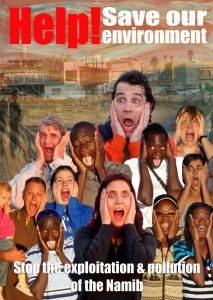
An Infinite Scream Public Intervention

An Infinite Scream Public Intervention

Dorob (NOT) 4Sale

This anonymous intervention used a tongue-in-cheek way to get people’s awareness about the sale-off of our natural resources. Fake estate agent for-sale signs were placed at prominent places along the main roads leading through the Namib desert, with messages that our desert and ocean are (NOT) for sale. The provided telephone number and Web address lead to further information and links to environmental initiatives. (More about this intervention: click here. )


Hand-painted Photographs of the Namib Desert

While I was in Berlin, I heard about the plans to build a large chemical plant in the Namib Desert. I imagined what the desert around that plant would look like, if the waste is not properly managed, like so often before or if something unforeseen happens. I painted these scenarios onto photographs of the desert. Later, when I returned to Namibia I used the ideas from the photos for temporary land-art installations.

Toxic Rocks & Poisonous Water

The neon paints might initially give the landscape a funky and modern look, which is quite pleasing, until we notice that this is not natural and healthy. I hope to make people understand that we have to take a second look and consider the different realities behind a situation. Yes, a chemical plant might bring job opportunities, but also illnesses and destruction to the environment. Only when we consider all aspects, can we make a good choice. What looks pretty at first, might turn out to be nasty in the long-run. (More about this artwork: click here and here.)


AJ: Could your art, even though its related to Africa, reflect the global narrative?

IR: Definitely! When I started off with my career, I thought I am working on personal issues which are directly connected to myself and my home-country. I very soon realized, that once you scratch under the surface, we are all human and have the same hopes and fears. Situations and patterns are so similar all over the world, but we are often too distracted to notice, because we focus on the thin superficial differences.

Not all countries are desert countries, but still we all are exposed to and dependent on our environment. A country with plenty of water also needs to manage their resources. They might not need a rainmaker, but through my artwork they could feel inspired to play with alternative ways of interacting with and caring for their environment, and minimize the danger of floods for example.

ANJ: Do you have any comments you would like to add? 

IR: Thank you so much for your interest in my work and this opportunity to make it visible to more people worldwide.

Imke Rust busy installing 'Poisonous Water'

Imke Rust busy installing ‘Poisonous Water’

Thank you Ms Nassehi Javan for letting me share our interview here! It has been such a pleasure getting to know you and working with you.
My artwork seen from space

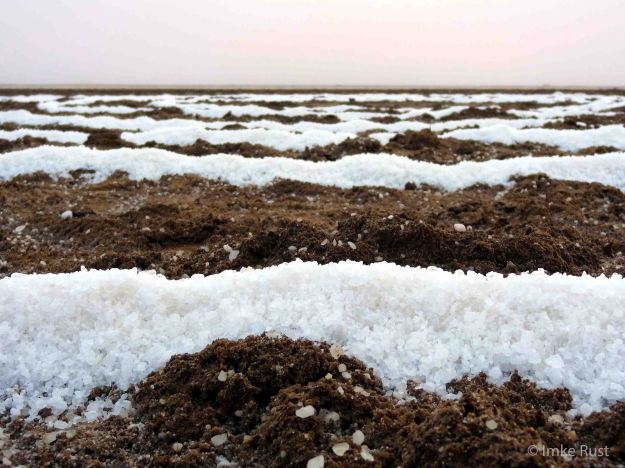
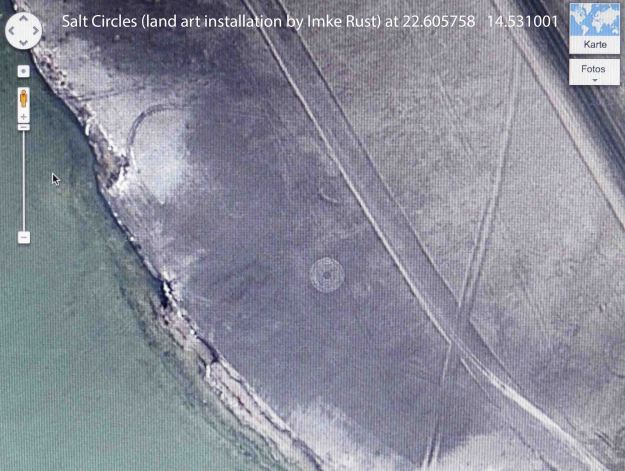
Wow – what a surprise! I just realised that Google has updated their satellite views, and one can clearly see my land art installations ‘Salt Circles’ right from outer space! Isn’t that cool?

Land art installation 'Salt Circles' by Imke Rust, as seen on Google Satellite View.

Land art installation ‘Salt Circles’ by Imke Rust, as seen on Google Satellite View. (Correct Coordinates: 22° 36’ 21” S,14° 31’ 51” E)

I have taken this photo from my screen, but you can go and have a look on Google Maps/Satellite View yourself. (Coordinates: 22° 36’ 21” S,14° 31’ 51” E)

Even if one cannot see each circle on its own, one can clearly see the smallest and largest circle and some lighter/white shade in between.

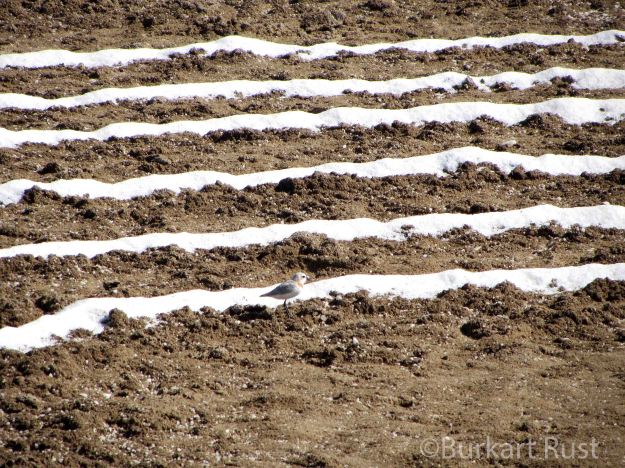
And I have another special treat for you! Outer space pictures are amazing, but looking very closely at something is equally breathtaking. Here are some close up pictures, taken by my father a few months after completion of the installation:

chestnut banded plover in the centre of my salt installation

Chestnut banded plover (near threatened species) in the centre of my salt installation

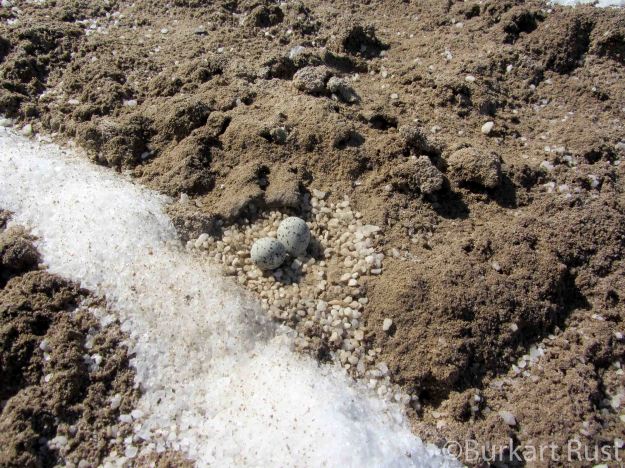
While photographing the salt circles for me, my father noticed this chestnut banded plover (thank you to Jean-Paul Roux for pointing out the correct name) in the centre of the circles, and the bird did not want to leave, dispite all the action. So on closer inspeciton my father found the reason why it was spending time in the centre of the salt circles:

Strandloopertjie nest with eggs

Strandloopertjie nest with eggs

Yes, she has choosen the salt ridges of the circles as perfect shelter for laying her eggs. 🙂 🙂 🙂

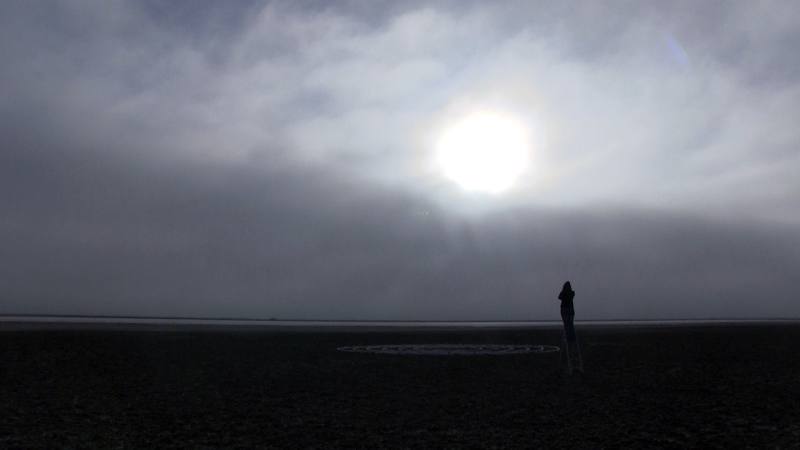
The artwork was supposed to be a symbolic blessing and protection of the surrounding land. The concentric circles were selected as a shape to symbolise the outward ripple-effect which I hope this blessing and protection would have. To me the nest of the bird seems to confirm in a small but beautiful way, that my intentions are recognised and appreciated by nature.

Another close-up view

Another close-up view

For more information and pictures of this artwork, click here.

Film production almost completed

An Inifinte Scream – The Documentary: Trailer

How did you make this? Where do you get all your ideas? Why are you working with salt? And what is a Tokoloshe Trap?

Did you ever wonder about these things when you see my art? Well, this time you are lucky and soon you will get some answers.

Documenting SubRosa IRust (c)

Documenting SubRosa IRust (c)

We have made a documentary film about my latest land art project ‘…and I sensed and infinite scream passing through the Namib’. It gives you a great behind-the-scene glimpse into the project and an insight how I work and think.

You can join me in the exciting journey from the making of the artworks, the thoughts behind them, the challenges along the way and finally the exhibition. It is a personal portrait as much as a film about the art and its role in society.

Until we can finally publicly release the film, you can already view the trailer and check out the film’s webpage. It will give you a taste of what to expect in the full documentary once it is released. Do not forget to sign up for the blog to find out when and where it will be screened. (I will also keep you updated here.)

A great thank you, to filmmaker and my partner Steffen Holzkamp for the excellent work and the super-cool film. I am really looking forward to sharing the full film with everybody soon.

Click HERE to view the trailer (1:36min)

Making of the Salt Circles © Imke Rust

Making of the Salt Circles © Imke Rust

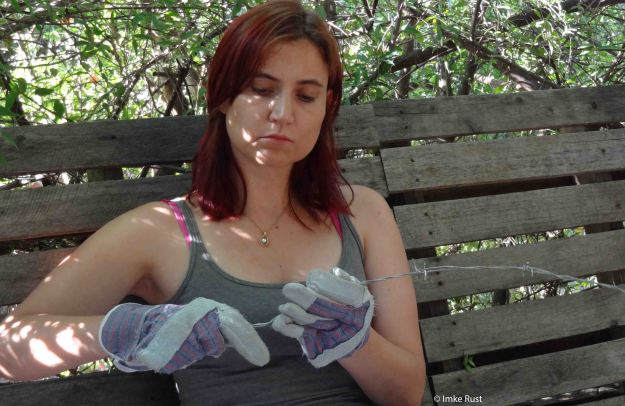
Making the barbed wire stems for the roses © Imke Rust

Making the barbed wire stems for the roses © Imke Rust

Secret ingredients for making rain…

IRust_DSC01338(c)

Ok, I have decided to share my secret list of ingredients for making rain with you 🙂 .

When we wish to manifest a different reality in our lives, we must firstly set a clear intention. Then we need to put the energy closest linked to that state into a creative act – such as art, music, dance or a ritual. Add a huge bucket of trust and stir in hands-full of patience. Regularly add generous amounts of gratitude and sprinkle with as much fun and creativity as you can find. Decorate with light-heartedness and celebration.

As you might have guessed, this is an update on my last post “Waiting for rain” and you are probably curious to hear if my little rainmaker was successful.

After I made my ‘little rainmaker’ and writing about it in my last post, nothing much happened for a few days. And I started to get doubts. Maybe the rainmaker was too small? Or maybe the stone which I selected, was wrong – after all, it came from the Namib desert, a place which seldom sees rain. Maybe it just had forgotten the feeling of rain? So just to be absolutely sure, I decided to remind the stone and myself of the feeling of water, by making it stand in water, and refilling the water every day, saying my thanks to nature.

IRust_DSC00944(c)

There was some rain on the 4th of February, but not much. Just enough that I decided to re-draw the cloud image and rain drops on the stone, as the image has been washed away a little bit. Through doing so, I reaffirmed my gratitude for every little drop of rain that we are getting.

IRust_DSC01277(c)

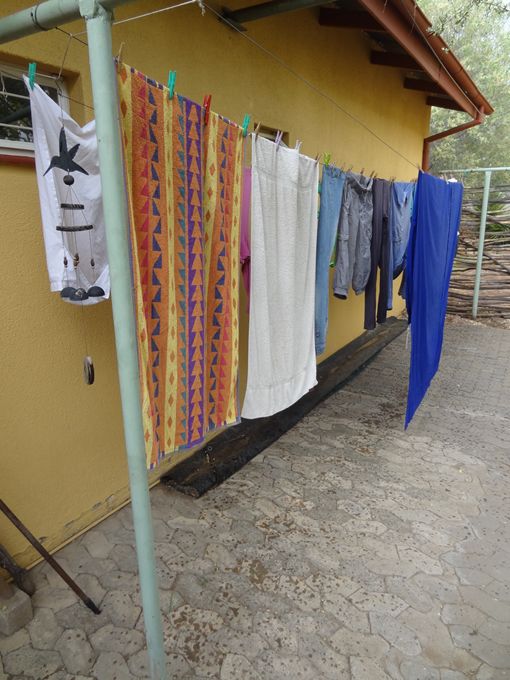
All the time I regularly thought about our believes and superstitions surrounding rain. As kids we were told that eating up your food would allow it to rain and I still say that to friends when they are over for dinner. In Namibia we also say that you must not run to take down the washing from the line, when the first drops fall, as this will surely chase away the rain…

So when the first drops appeared  I rather took a picture of my washing and the drops, happy about every little bit of moisture and not worry about it getting wet.  Quietly celebrating each one of the few drops which our sky managed to squeeze out of the promising clouds. Even if once again, the drops stopped coming soon after they started… (Note to self: the washing believe does not seem to hold water in either a literal or figurative way. 😉 )

Raindrops on my washing

Raindrops on my washing

First raindrops on the new rainmaker (7 Feb)

First raindrops on the new rainmaker (7 Feb)

On my birthday, the 7th of February, maybe as a special birthday gift, we had the first real rain. (Another note to self: it really takes a lot of patience, trust and many little prayers of thanks to get it to rain, but eventually it will rain.)

Ok, I acknowledge that I hoped the little rainmaker would bring lots of rain within two or three days. But maybe I just need more practice and more faith. And at least making and nurturing the little rainmaker  gave me a sense of being proactive and positive in a time, when many people are starting to be talking about the imminent drought that we might be facing this year with a doomsday face and spreading the fear.

I learned that even if we can (and should be able to) influence reality with the right intentions and actions  a little bit nature still has a way of following its own rhythms, but it might also be reminding us of some valuable lessons. We have been blessed with several really good rainy seasons and we have started to take water for granted again. We have wasted water, used it without being conscious about our actions or without remembering how very blessed we are and saying thanks.

And even if my little rainmaker has not yet brought Namibia or my garden the wonderful rains which I hoped for, I still have faith that we will also survive this year and this season.And that the rain might still come…

Last, but not least the little rainmaker provided me with regular joy watching the wild animals coming to drink from my installation. In the very first picture is a wild yellow mongoose and below is a red-eyed bird. I do not know the scientific name of the bird, but I happen to know this bird personally, as I had the pleasure to share its life for the past few months. She and her husband have nested in my garden and I could watch them raise their young chick, teaching it to fly and celebrate life.

Red-eyed bird drinking from the rainmaker installation

Red-eyed bird drinking from the rainmaker installation

Waiting for Rain

It is very hot and dry. All Namibians are yearning for the rain to come. So am I.

I have decided to make another, small ‘rainmaker’ work and place it in my garden in hope to set the right energies free to let there be rain. I have made my first “Rainmaker” artwork in 2010. You can click here to be taken to pictures and information on that 🙂 .

For some time now I have been experimenting with the idea that combining creative energy and ritual with the right intentions should be able to influence the ‘reality’. In simple terms: I am trying to figure out, if a rain dance can really produce rain.

And if so, what ingredients are needed? Are there specific magical forms, rhythms, sounds or actions that are needed? Do we really need to dance to get rain, or could it be another creative expression? (Since I am not a dancer, this question is actually quite on top of my list…)

While I am still hoping to one day stumble on a copy of “Rain Dancing for Dummies”, I have settled to do a lot of reading in related matters, from traditional beliefs and cultures from all over the world to artists who have explored similar concepts, like Joseph Beuys.

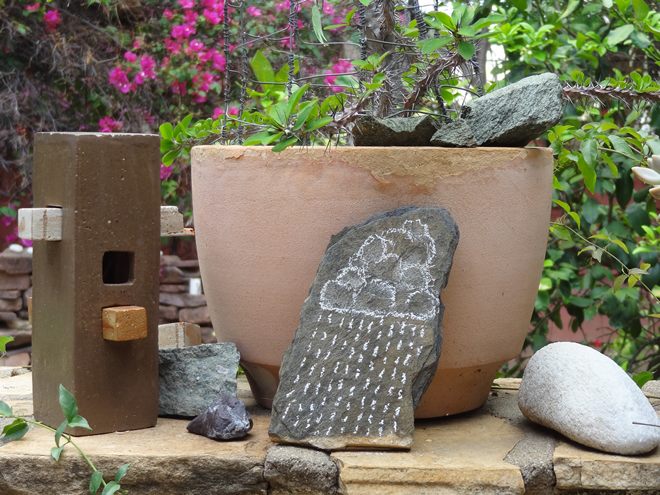
And while I am at it, I thought, it will not harm to start experimenting with it already. So here are some pictures of my drawing of a raining cloud made to focus the intention on the reality which I would like to see and feel.

I have made it a few days ago and yesterday there were some promising clouds but no rain. Today there are some more clouds, so I am keeping my fingers crossed… and my intentions focused on the cool refreshing wetness of rain…

Rainmaker on my stoep (local word for verandah)

Rainmaker on my stoep (that is what Namibians call a verandah)

20cm high flat stone, sepcially collected for this purpose from the Namib. I made the drawing with white Chalk drawing.

+-20cm high flat stone, specially collected for this purpose from the Namib. I made the drawing with white Chalk, so that it can wash off with the first rain…

Some clouds in the sky in the day I have made the drawing.

Some clouds in the sky on the day I have made the drawing.


Interview on the German radio

Do you understand German and would like to listen to an interview about my latest art exhibition?
Then I invite you to please tune in to the NBC German Radio Station on Sunday, 13 January 13 at 18h00 (Namibian time).For those of you who are not living in Namibia, you can listen to the interview on NBC’s livestream via the internet @ http://96.31.83.87:8110/ . If you have missed that one or cannot make it, don’t worry, there will be a re-broadcast on THURSDAY at 22h00 (17 January).

The program’s name is Kaleidoskop and it will feature a 30min interview with me, hosted by Annemarie Brell. The interview will give you an insight into my views on environmental art, we are talking about my works that have been exhibited recently in Swakopmund at my solo exhibition “…and I sensed an infinite scream passing through the Namib” and I share information how the works originated and what my intentions are.

Many people have commented that they have really enjoyed my earlier brief interview done in the beginning of December, just after the opening of the exhibition, so I hope this will be equally interesting. 🙂

You can find more information on the radio station’s Facebook page: https://www.facebook.com/germanradio

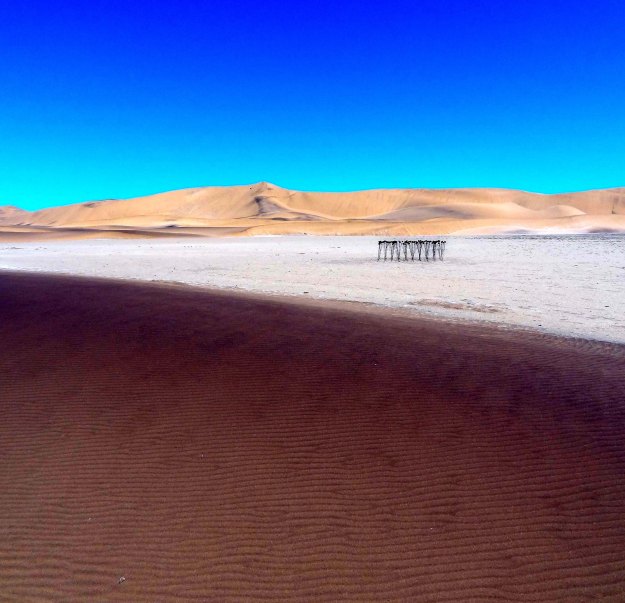
Me busy installing the 99 black roses (made out of barbed wire and rubbish bags) in the Namib desert for a temporary site-specific installation.

Me busy installing the 99 black roses (made out of barbed wire and rubbish bags) in the Namib desert for a temporary site-specific installation.

Pictures from the Opening

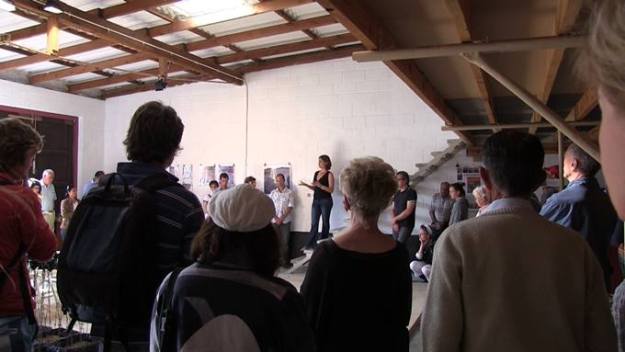
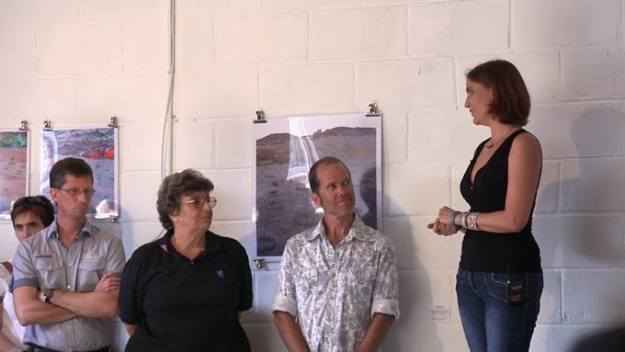
IRust_Ausstellung_O_sFinally I have time to share some pictures of the opening of my latest solo-exhibition. It opened to great many people on Sunday the 9th of December in Swakopmund on the premises of “The Last Resort Well/ness Centre” (Yes, that is how it is written for a good reason). I did not count, but the newspaper said there were at least 150 people for the opening. And I got so much wonderful comments and feedback! Wow! Thank you to everybody who came! And those of you who have missed the opening, you still have time to see the exhibition (without the pushing and shoving of so many people) every afternoon between 14h00 and 18h00, except Sundays, till the 29th of December. I am at the exhibition all the time, if you would like to meet me. I would sure love to hear your thoughts, meet old and new friends and share my art with you!

IRust_Ausstellung_F_s


IRust_Ausstellung_D_s

IRust_Ausstellung_L_sIRust_Ausstellung_G_sIRust_Ausstellung_I_s


All photographs taken by Steffen Holzkamp. (Copyright)

The opening speech, with Clinton Lang from "The Last Resort Well/ness Centre" in the middle.

The opening speech, with Clinton Lang from “The Last Resort Well/ness Centre” in the middle.

An Infinite Scream – Press-Release


SubRosa
Temporary site-specific art installation by Imke Rust


What do you do, when an arts association cancels your exhibition because they find it too political? And when a cultural centre asks you to change your exhibition proposal to hide the true message so that it might stand a chance of being shown?  You make sure it gets shown anyway, in an unbiased space.

And so Imke Rust’s latest solo exhibition, entitled ‘… and I sensed an infinite scream passing through the Namib’  will open at “The Last Resort Wellness Centre” in Libertina Amathila Ave 5, Swakopmund (opposite of Hotel Pension A la Mer) on the 9th of December at 17h00. It can be viewed thereafter till the 29th of December, between 14h00 and 18h00, Mondays till Saturdays.

In this environmental art exhibition Imke Rust, who grew up in Swakopmund and is still closely connected to it, addresses the current debates and happenings concerning the plans for increased mining and industrial activities in the coastal area. In her work she uses a variety of media and approaches to highlight the concerns of the general public and to search for alternative solutions in the environmental conflict. While she is painting a gloomy picture of possible disastrous long-term effects of the current developments, she also reminds people of their responsibility to look after their land and that they have the power to make changes towards a better future.

Once more, Imke Rust has produced a powerful body of work, exploring and openly questioning social and political controversial issues. Central to the exhibition are temporary land art works that the artist has installed in the Namib Desert.  At the exhibition these installations and interventions will be presented through photographic and video documentation. She evocatively combines natural and man-made materials such as thorns, salt, dung, rubbish bags, barbed wire and videos in her captivating artworks.  She even got complete strangers involved in a documented art action for the environment on the jetty.

The artist neither preaches nor dictates what the viewer’s stance should be. Instead the exhibition draws you in and compels you to engage and consider the complexities of the debate. It is an empowering experience and should definitely not be missed. 

A small part of the exhibition has already been shown in Berlin earlier this year, where it was received with great interest. Intriguingly the Swakopmund Arts Association has cancelled Rust’s booking of the Woermann Gallery on the premises that the “impertinent and unscientific public debate against the economically important uranium mining industry […] is politically charged“. 

For more information please contact me via this blog and webpage or find my artist page on Facebook (and like it, if you are also on Facebook 🙂 ) or go directly to the Event’s page, also on Facebook.

Looking forward to seeing many of you at the opening or afterwards!

The Last Resort Well/ness Centre – Swakopmund
Libertina Amathila Ave 5

Can art do more?

Imke Rust Saltcircles

Photographing the first day’s work of the ‘Saltcircles’ during a misty sunset. (photograph by Steffen Holzkamp)

Art can be thought-provoking, inspiring and make the world more beautiful. But can it do more?

Part of my being is that I question everything. I love understanding the relations between things, the ‘why?’ of everything. I also love to find alternative solutions to problems or do things other people think cannot be done.

Often I ask myself, why am I doing art? What ‘real’ purpose does it serve? And can it do more than just look pretty, be a clever idea or make people think? Somehow all these things have not yet completely satisfied me. Yes, they all have merit and even a purely decorative painting has its purpose, but I believe there is more to life and more to art.

This has led my search, amongst others, to old, shamanic traditions. Somewhere during my art history studies I came across a reference to Ethiopian healing scrolls. If a person was sick, the priest would make scrolls according to specific rules (for instance the scroll needed to be as long as the person’s height, if I remember correctly), on which they painted symbols and wrote prayers. These scrolls were then taken home by the sick person and were viewed every day till the illness was cured. Interesting – art made to heal somebody?

Again and again I stumbled onto references where art is used for protection, fertility, health, initiation or to manifest a desired state. I became more aware that in olden days the shamans and priests made use of what we today call art (dance, painting, sculpture, music, etc.) to do their work of healing, blessing and manifesting. Since I read about the healing scrolls, I have been looking at the link between art and spiritual and mythical traditions and beliefs more closely. I do believe that under certain circumstances, art has more power and effect than what we normally imagine, and so I decided to try and be much more conscious about what kind of art I am making and why and how…

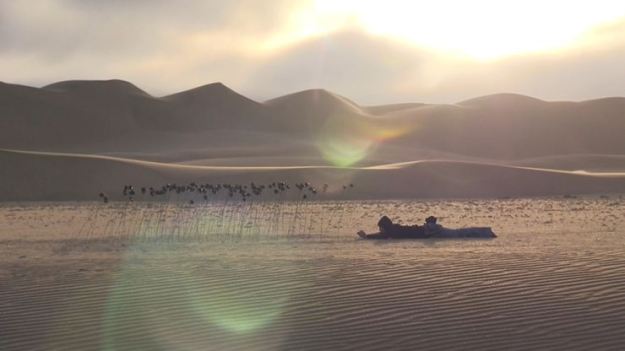
Working in the Moon valley, Namib Desert

Working in the Moon Valley, Namib Desert (Photograph by Steffen Holzkamp)

Be the change that you want to see in the world

In 2007 I made my first conscious work into this direction. I developed a personal Yin & Yang symbol to harmonize and balance the male and female energies in my life (Click here if you are curious). In 2010, I hoped for rain and made a work entitled ‘Rainmaker’ (read more about it here) – this was the start of becoming more interested in working directly in nature. Towards the end of last year the general concern about the environmental threats posed to the Namib desert by increased mining and industrial activities and proposed plans for off-shore mining of phosphate on the Namibian coast, started growing. Having grown up in Swakopmund and still considering it one of my homes, I, too, am concerned and decided to find ways in which I can do my part “to make the world a better place” and protecting the environment.

I realized that protesting or being against what I consider to be a threat is not the way to change things – or at least not my way. Instead I looked at ways of putting energy into the reality I would like to experience: a balanced, healthy and protected environment, in which all beings co-exist in a harmonious way, without destroying each other. This is based on the spiritual idea of ‘what you sow is what you reap’.

Planting black 'roses' in the Namib Desert

Planting black ‘roses’ in the Namib Desert (Photograph by Steffen Holzkamp)

The works had to fulfill at least one of two different purposes:

  1. to protect, bless and heal the land
  2. to make the threats visible and conscious, because if you have looked into the eyes of the danger, you understand it better and loose the fear and can act from a stronger base.

Loosely based on different aspects of old shamanic and spiritual traditions from all over the world, I tried to find my own formal approach, use of form, symbols, rituals and materials according to my intentions to produce my art or healing works.

Click here to be taken to see a small selection of the resulting artworks and brief descriptions.

I appeared back to back with Madonna in Berlin

Yes, it is true. This weekend I appeared back to back with Madonna right here in Berlin. You are right, my musical talent sucks, but my art is getting more and more famous.

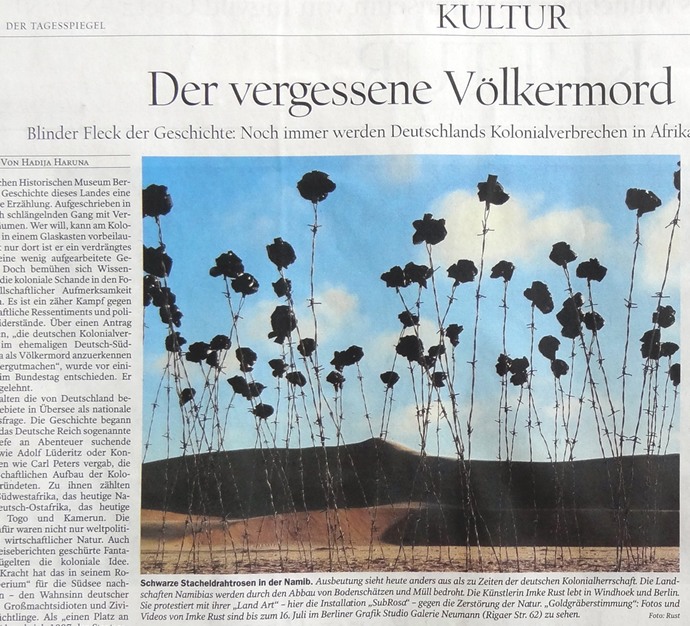
Ok, I did not appear on stage, but while the superstar Madonna got the front page of the cultural supplement of the German magazine “Der Tagesspiegel” this past weekend, my artwork appeared on the very next page – basically back to back.

I have to admit that I am not a fan of her music, but I do really admire how she has made it from a small unknown girl to become one of the most famous female musicians in the world, with pure guts, hard work and determination.

And I am just overly excited that I, a ‘small Namibian girl’, am having a solo exhibition in Berlin and getting a prominent mention in a leading newspaper… I hope that this is another small big step towards making my mark in Germany and get some more recognition (and sales) for my art. It would be wonderful if my artwork caught the eyes and attention of a small percentage of their 350 000 readers.

The more attention my art gets the more attention the subject and cause behind the exhibition will get:  Raising the consciousness about our Namibian environment, especially the coastal area and Namib desert and the possible threats from the mining and other industries and pollution.

Here is a cut-out from the newspaper:

Tagesspiegel 30 June 2012

Tagesspiegel 30 June 2012 Cultural pages with a picture of my work SubRosa.

The caption says:

Black barbed wire roses in the Namib. Today the exploitation  looks differently than in the times of the German colonial power. The landscapes of Namibia are threatened by the mining of natural resources and pollution. The artist Imke Rust lives in Windhoek and Berlin. She protests with her ‘land art’ – here the installation “SubRosa” – against the destruction of the nature. “Goldgräberstimmung”: Photos and videos by Imke Rust can be viewed up to the 16th of July in the Berlin Grafik Studio Galerie Neumann (Rigaer Str 62). “

If you are interested, you can read the online version of the “Tagesspiegel” here.

Info about the work:

SubRosa (Under the Rose) by Imke Rust

 Temporary installation in the Namib Desert Dune belt south of Swakopmund.
22° 43’ 01” S – 14° 33’ 47” E
Original dimensions: 90 x 270 x270cm
99 roses made of black rubbish bags, barbed wire, wire
April 2012