Intervention Against Tasteless Wall Decorations in Hotels and Holiday Apartments.
Intervention gegen geschmacklose Wanddekoration in Hotelzimmern und Ferienwohnungen. (Deutscher Text unten)
Since 2010 I have secretly been slightly altering tasteless or boring hotel or holiday apartment art whenever I had the chance to.
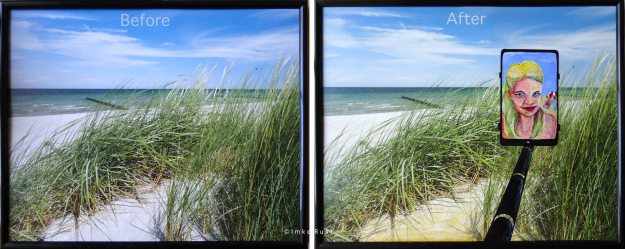
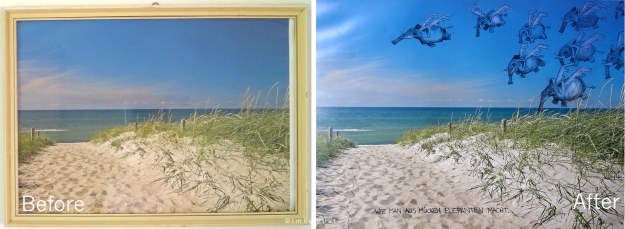
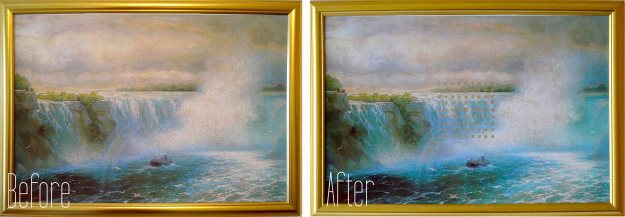
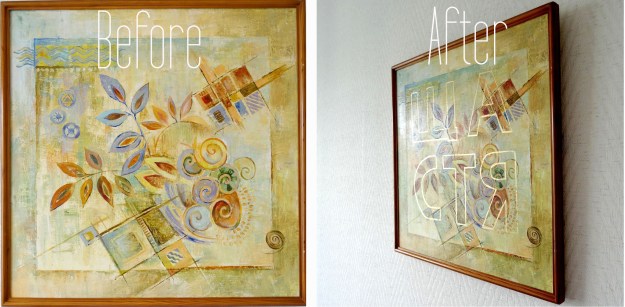
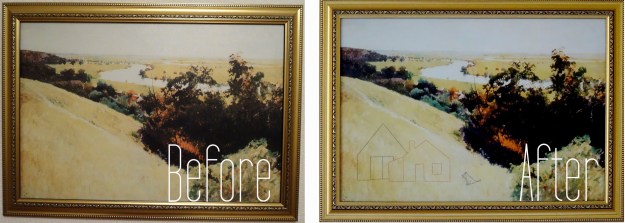
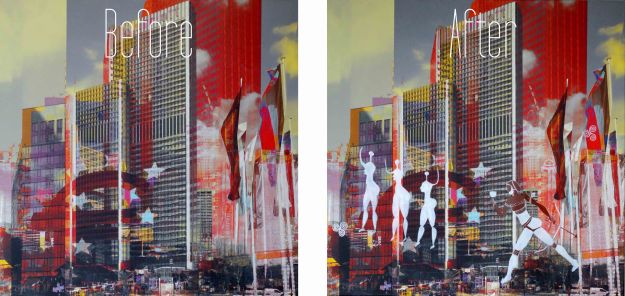
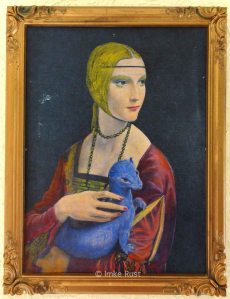
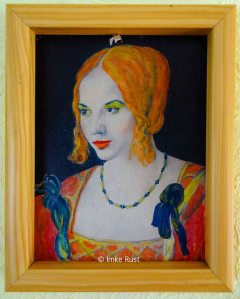
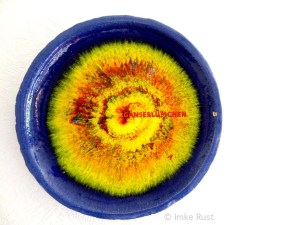
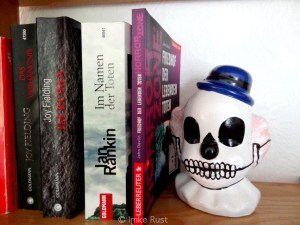
Hotel Deco Busting (since 2012) is an ongoing series of subtle artistic interventions in the semi-public spaces of hotels and holiday apartments. The project addresses the pervasive use of standardized, mass-produced wall decorations that function less as artworks than as visual placeholders designed to neutralize space and avoid aesthetic friction.
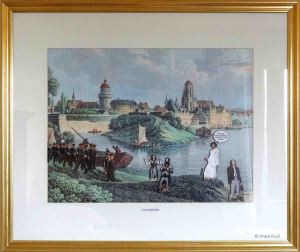
The interventions consist of minimal, often barely perceptible alterations to existing images. These small shifts—typically recognizable only on closer inspection—interrupt the logic of decoration and transform anonymous, interchangeable pictures into singular, site- and situation-specific works. In some cases, a short note placed on the reverse of the image identifies the intervention as a conscious artistic act.
Art-historically, Hotel Deco Busting can be situated at the intersection of institutional critique, appropriation strategies, and conceptual practices of minimal intervention. Rather than targeting “bad taste” as such, the project interrogates the depoliticization of aesthetic decisions in commercial environments. Hotels and holiday accommodations are treated as a particular form of public space in which perception, comfort, and consumption are carefully regulated through visual means.
The series raises fundamental questions about the role of art in everyday contexts: How agreeable must art be in spaces designed for relaxation? Where does decoration end and artistic agency begin? And what responsibilities do institutions have toward their audiences in presenting something as “art”? By transforming rather than replacing existing images, Hotel Deco Busting foregrounds attentiveness, context, and the possibility of activating artistic meaning within seemingly banal structures.
The interventions are documented and published online, positioning the project as an open, process-based and discursive practice.
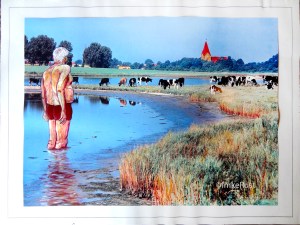
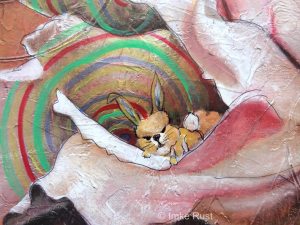
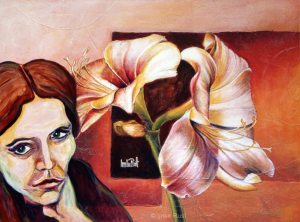
Click on the images to be taken to the pages with more information and pictures of each project.
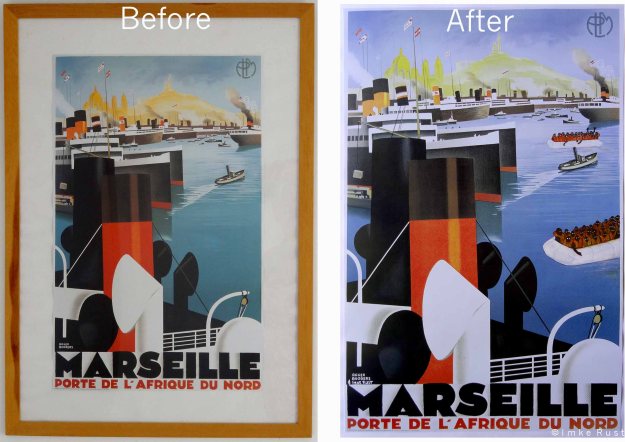
Marseille Porte de l’Afrique du Nord with refugees added.
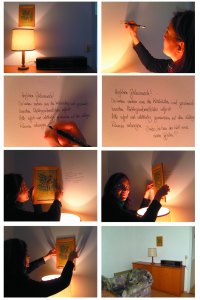
Hotel Deco Busting (seit 2012) ist eine fortlaufende Serie subtiler künstlerischer Interventionen im semi-öffentlichen Raum von Hotels und Ferienapartments. Ausgangspunkt ist die allgegenwärtige, funktionalisierte Wanddekoration dieser Orte: austauschbare, massenproduzierte Bilder, die weniger als Kunst denn als visuelle Beruhigung oder neutrale Platzhalter fungieren.
Die Interventionen bestehen in minimalen, oft erst auf den zweiten Blick wahrnehmbaren Veränderungen dieser vorhandenen Bilder. Durch gezielte Eingriffe – Verschiebungen, Ergänzungen oder Irritationen – werden die Werke aus ihrer Rolle als dekoratives Beiwerk gelöst und in singuläre, orts- und situationsspezifische Arbeiten überführt. In einzelnen Fällen ergänzt eine rückseitige Notiz den Eingriff und macht die Veränderung als bewussten künstlerischen Akt lesbar.
Kunsthistorisch lässt sich die Serie im Spannungsfeld von Institutionskritik, Appropriation Art und konzeptuellen Strategien der Minimalintervention verorten. Hotel Deco Busting richtet sich weniger gegen „schlechten Geschmack“ als gegen die Selbstverständlichkeit, mit der ästhetische Entscheidungen in kommerziellen Räumen entpolitisiert und entleert werden. Hotels und Ferienunterkünfte erscheinen hier als spezifische Form öffentlicher Räume, in denen Wahrnehmung, Konsum und Erholung normiert und visuell reguliert werden.
Die Arbeit stellt grundlegende Fragen nach dem Status von Kunst im Alltag: Wie gefällig muss Kunst in solchen Kontexten sein? Wo verläuft die Grenze zwischen Dekoration und künstlerischer Setzung? Und welche Verantwortung tragen Betreiber*innen gegenüber ihren Gästen in der Auswahl dessen, was als „Kunst“ präsentiert wird? Indem bestehende Bilder nicht ersetzt, sondern transformiert werden, plädiert die Serie für Aufmerksamkeit, Kontextbewusstsein und die Möglichkeit, auch innerhalb scheinbar banaler Strukturen künstlerische Autorschaft und Bedeutung zu aktivieren.
Die Dokumentation der Eingriffe wurde fortlaufend online veröffentlicht und macht die Arbeit als diskursive, offene Praxis sichtbar.
 Imke Rust